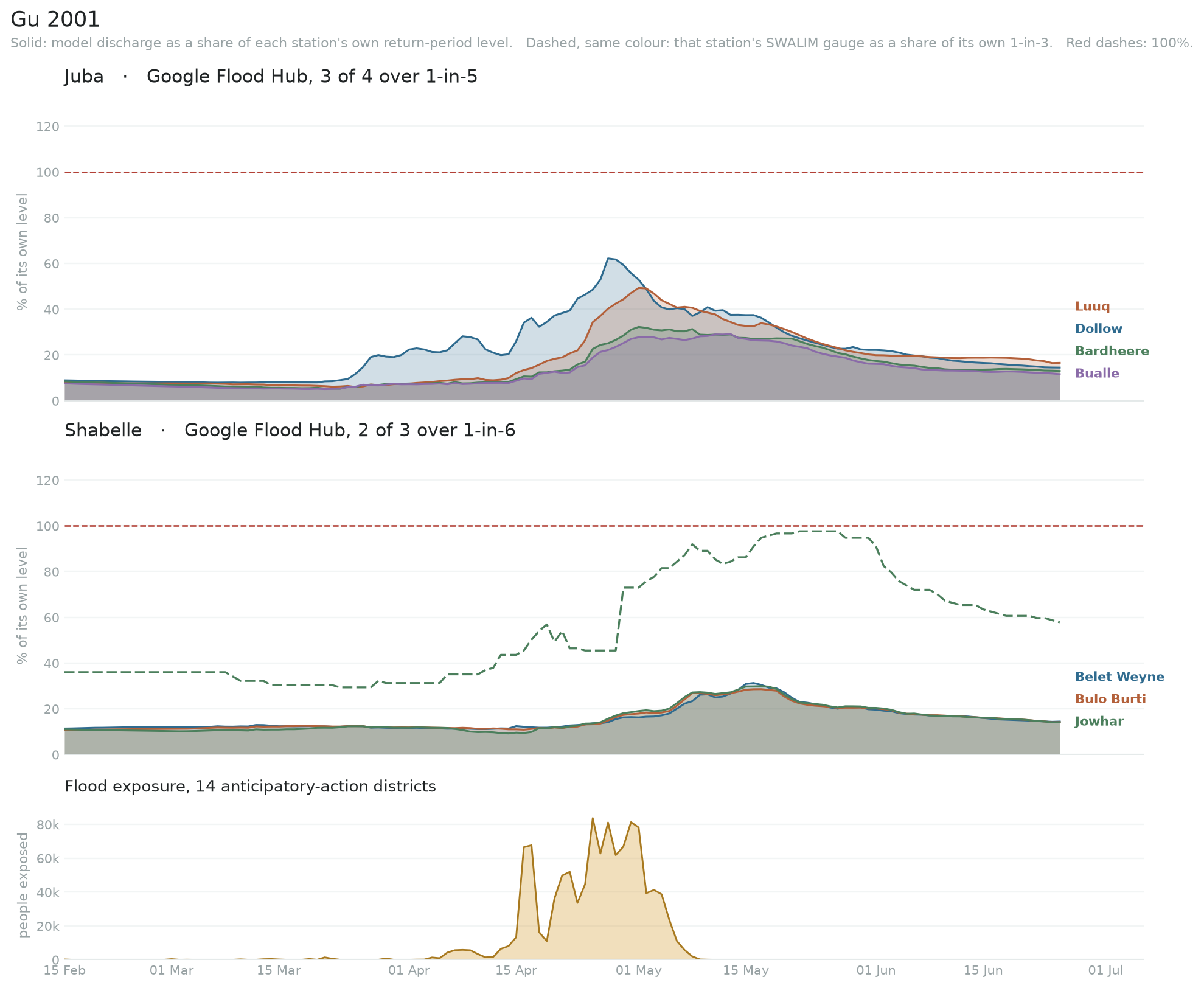
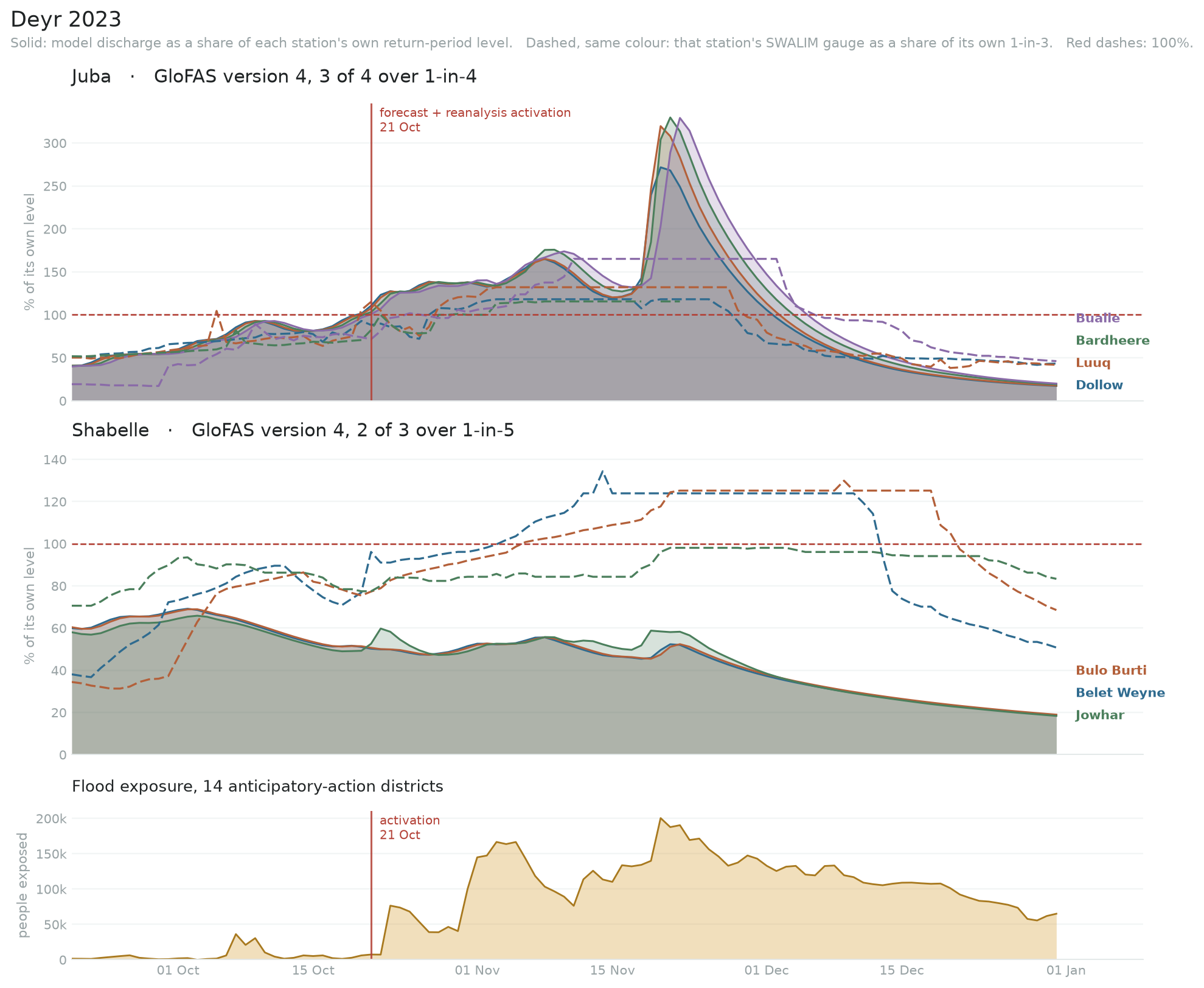
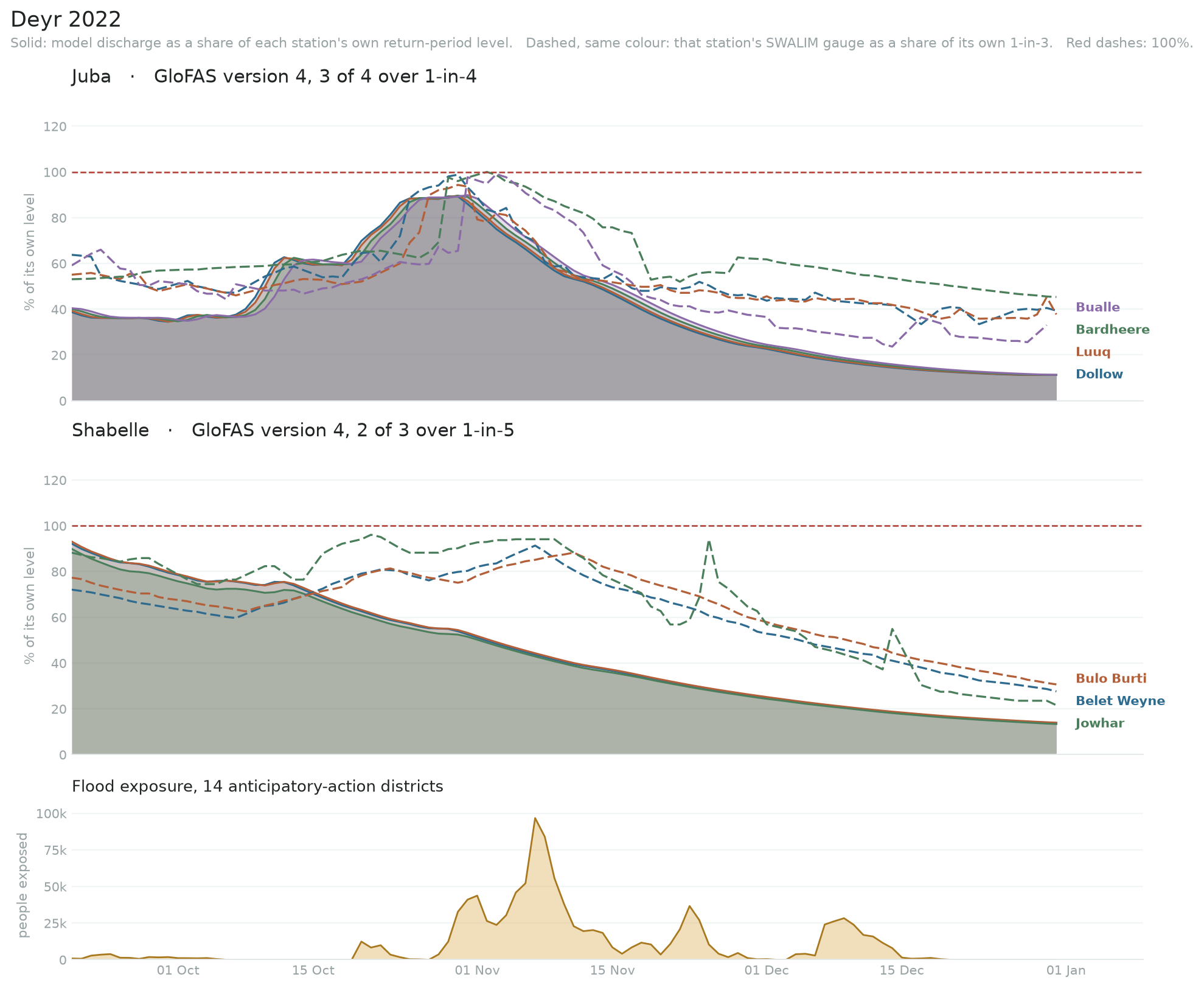
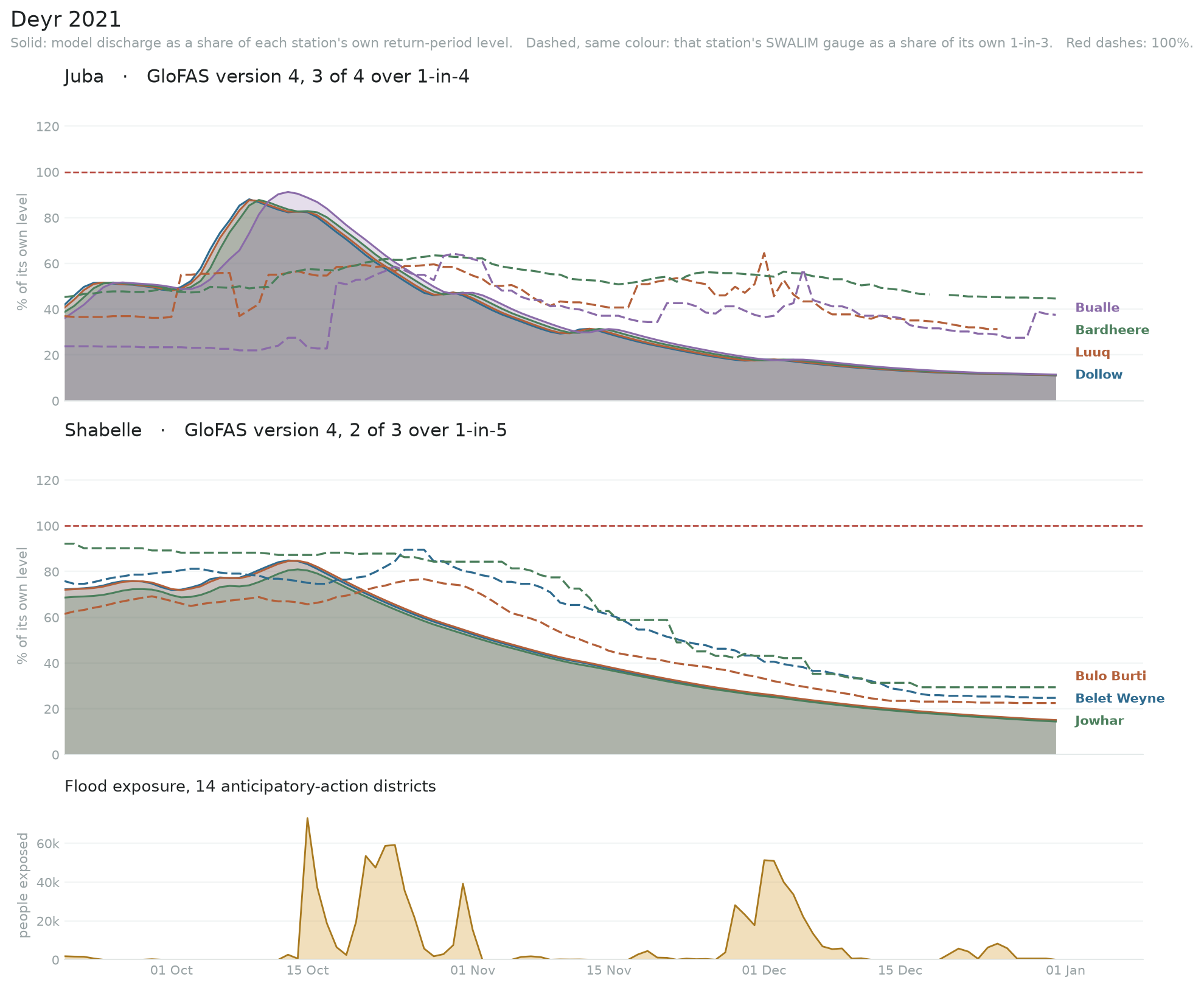
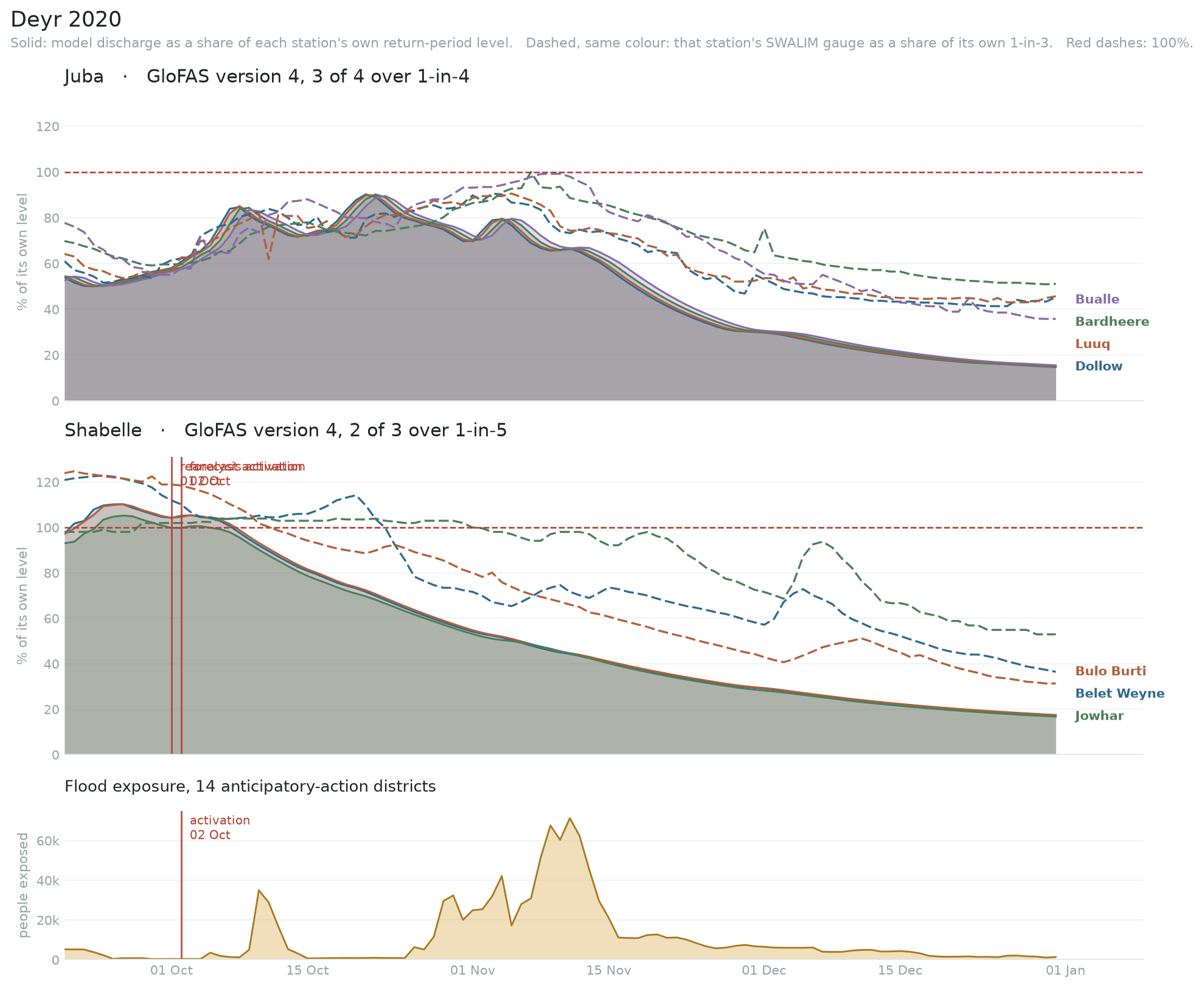
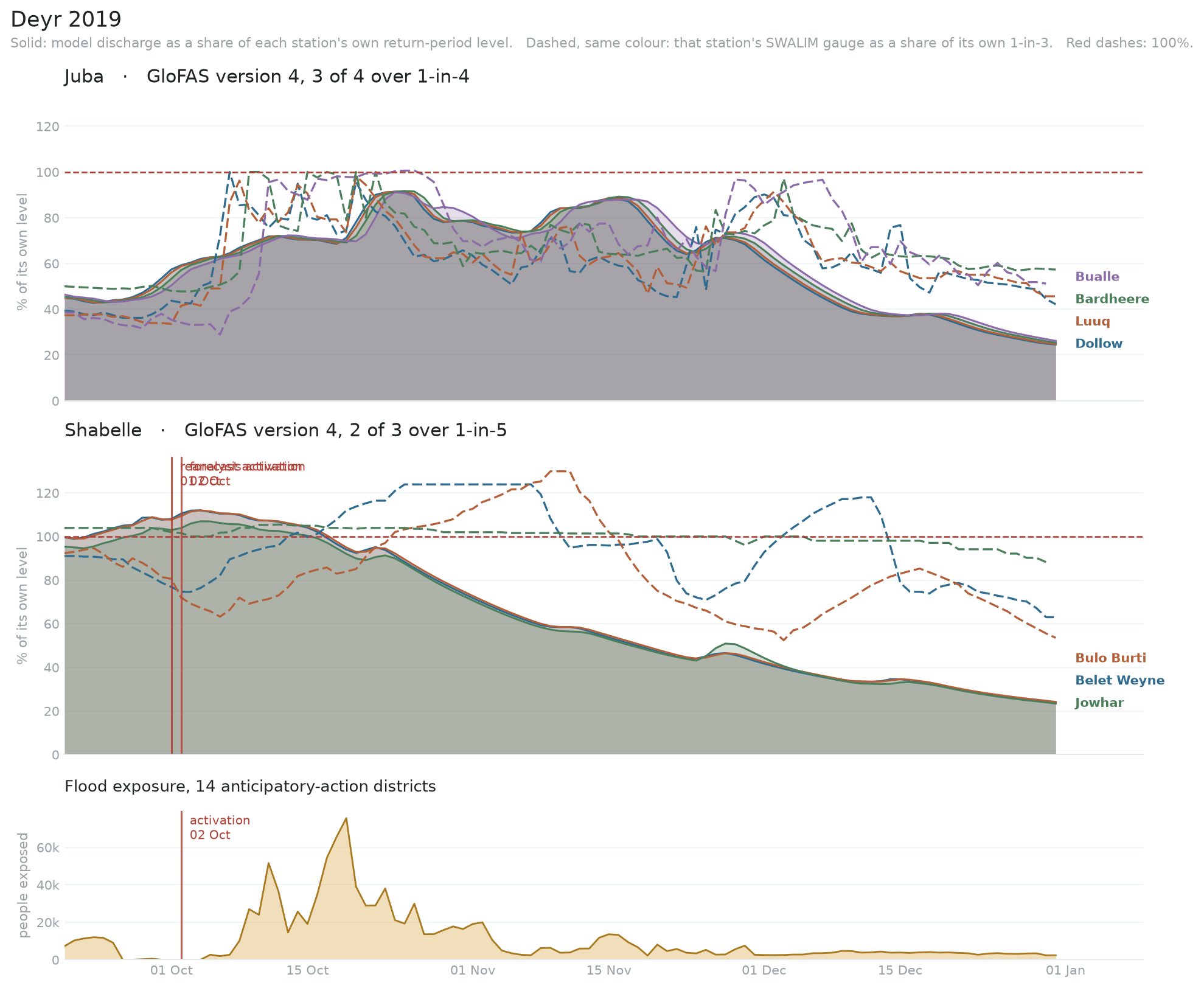
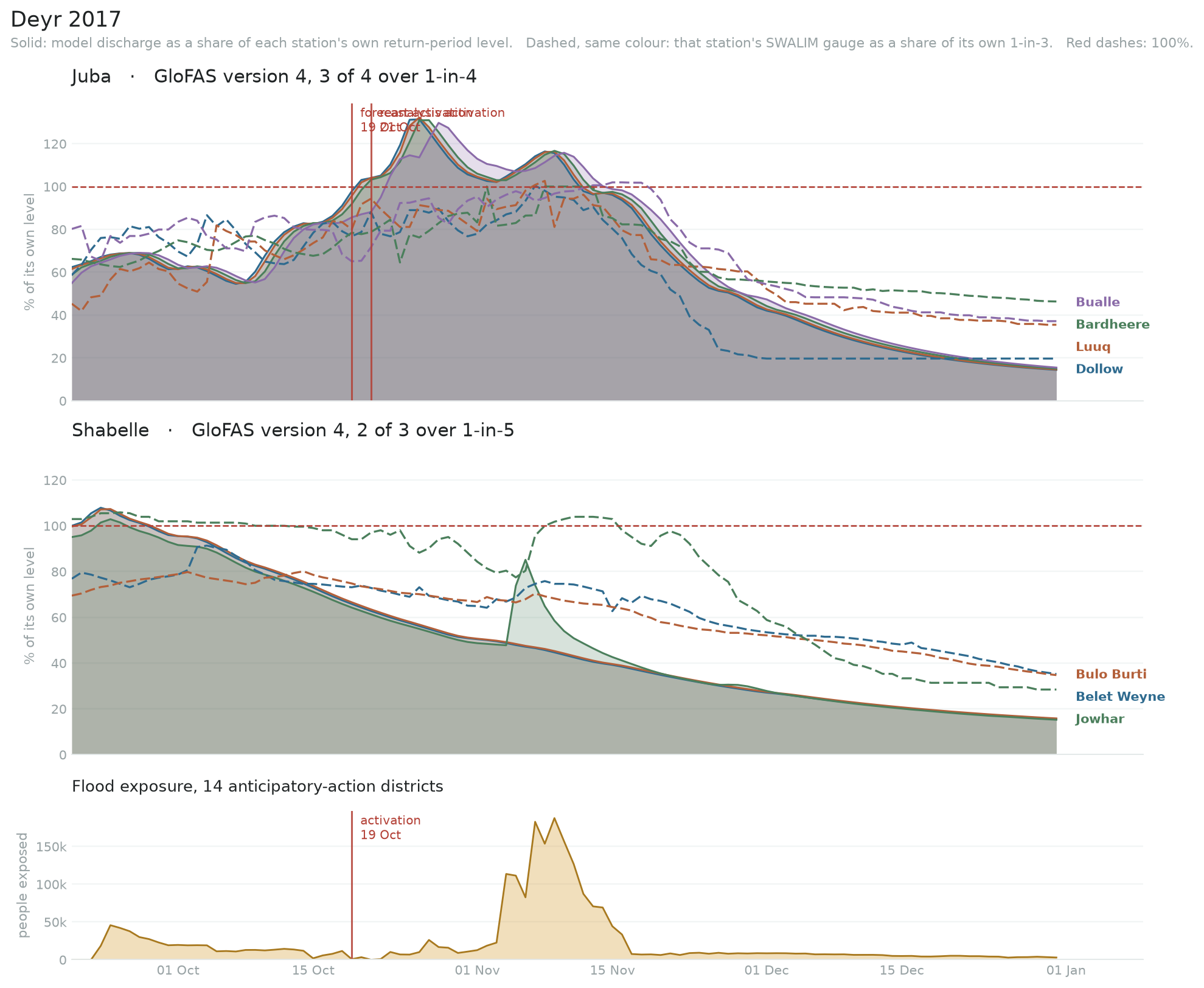
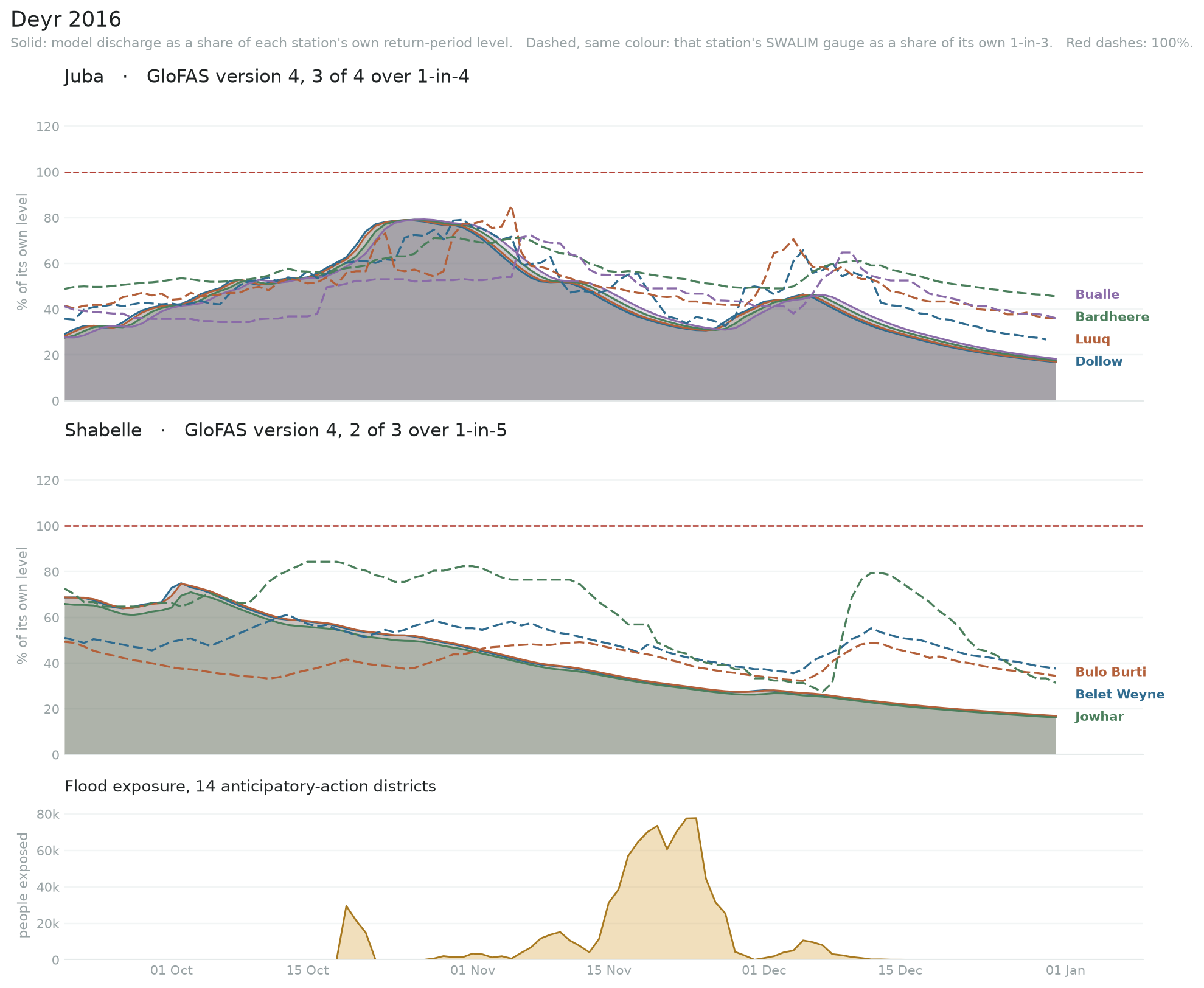
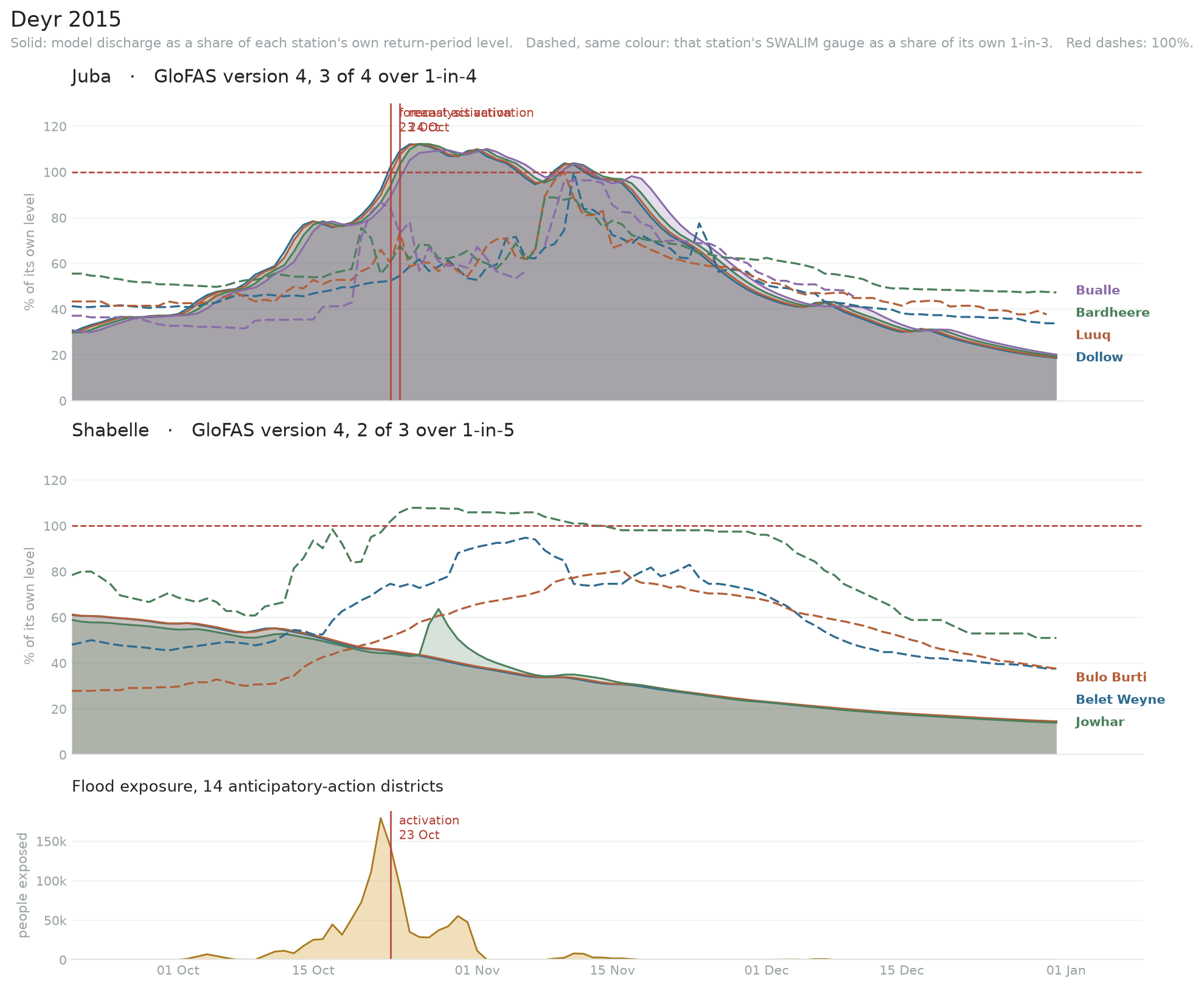
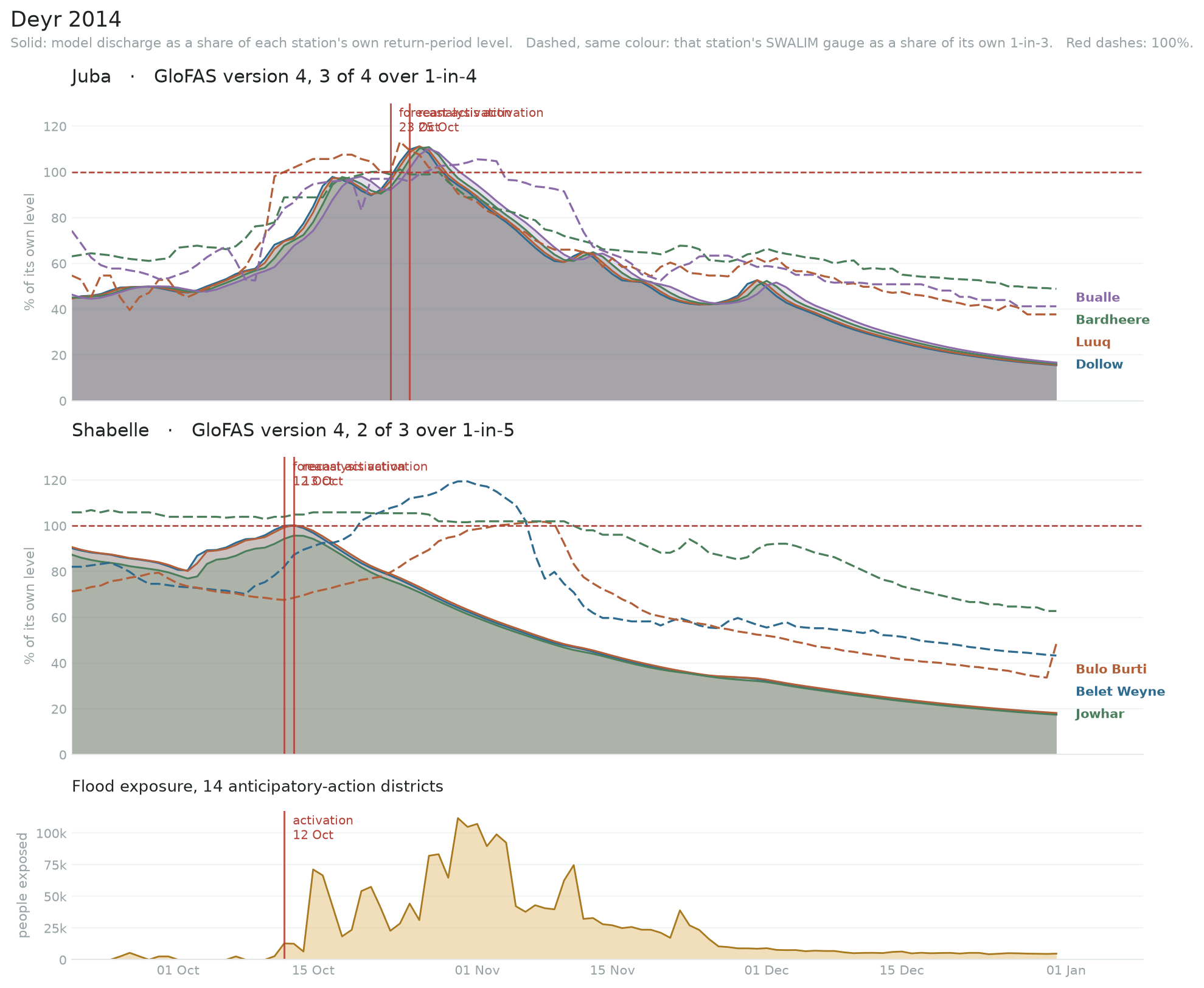
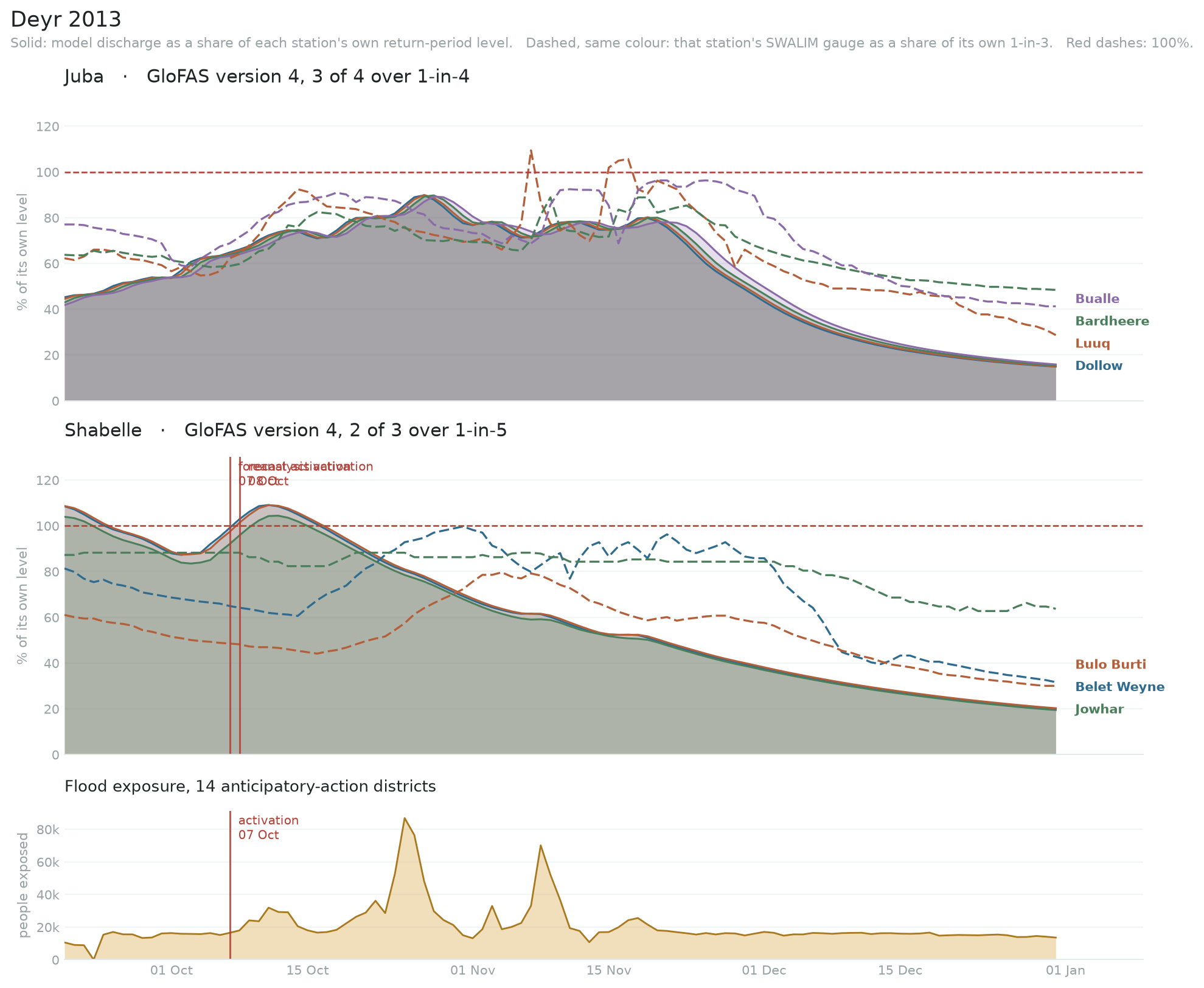
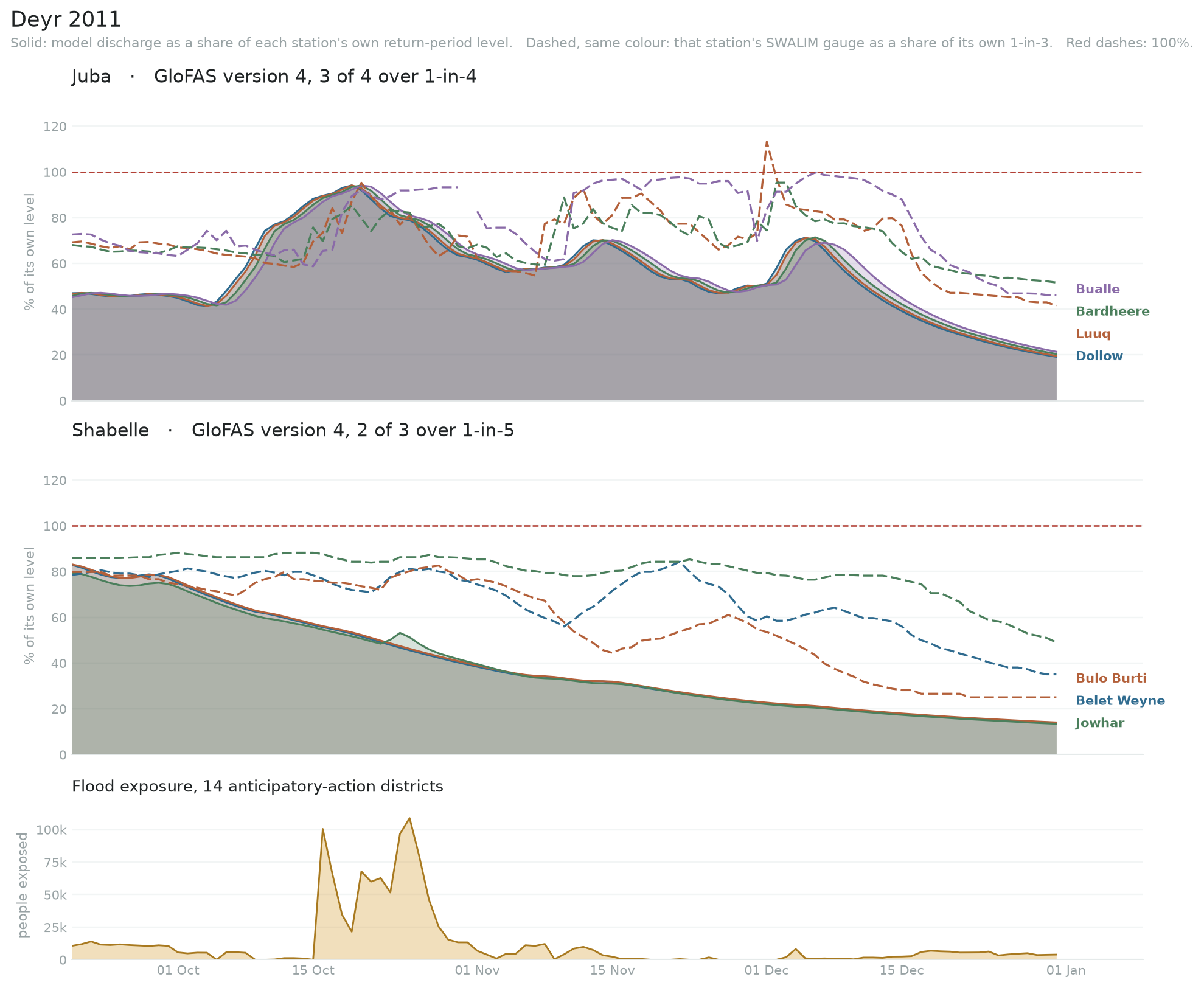
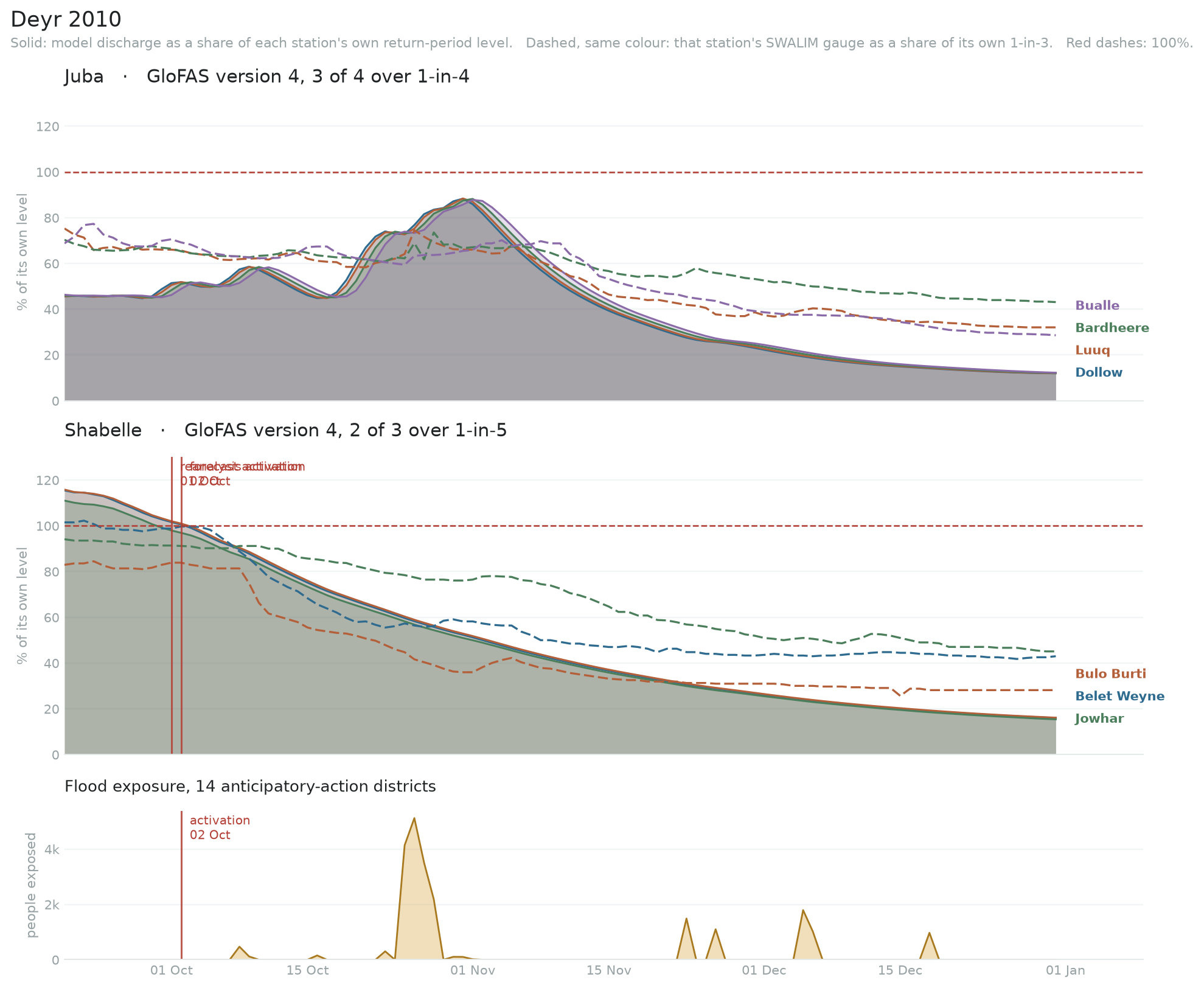
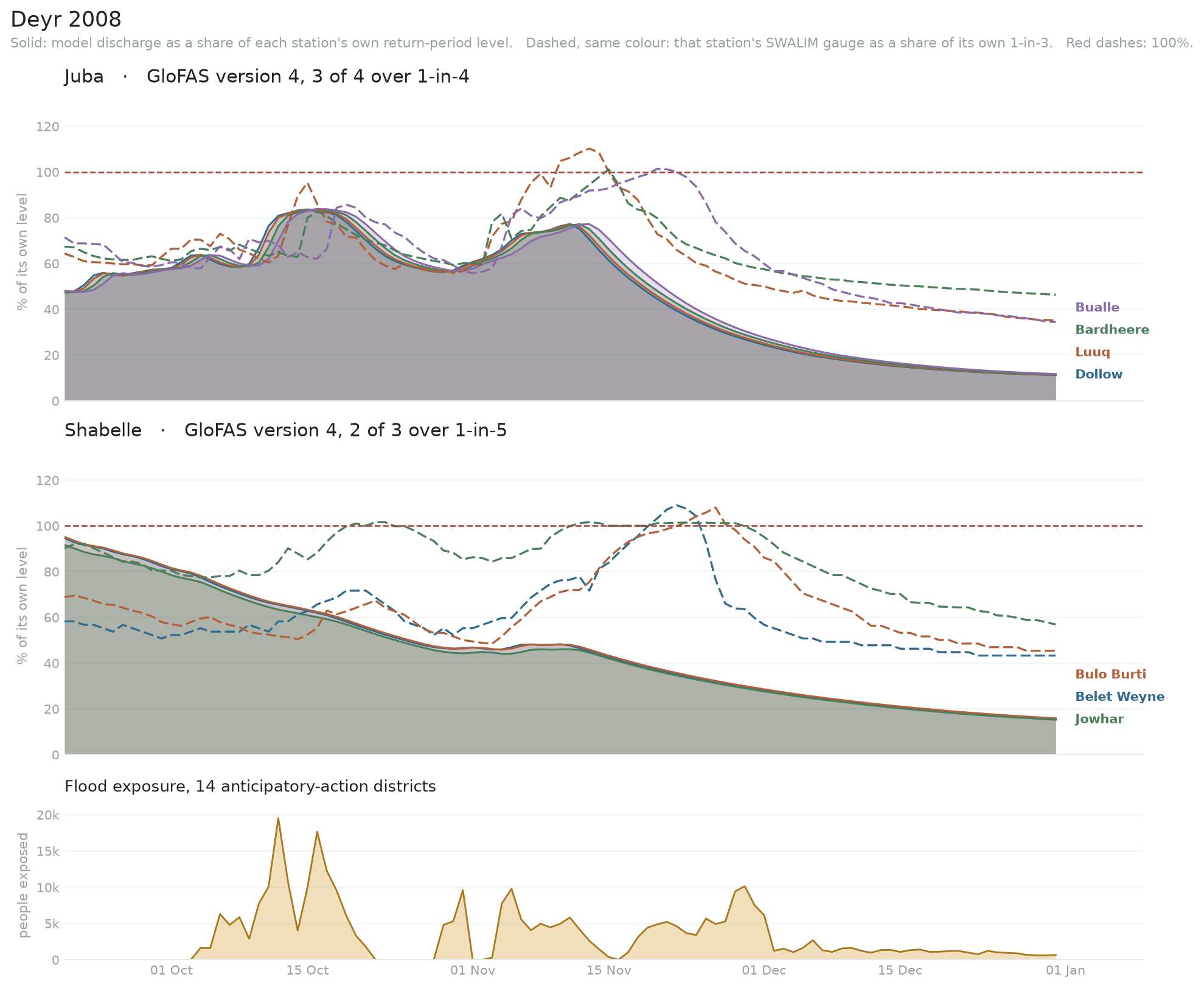
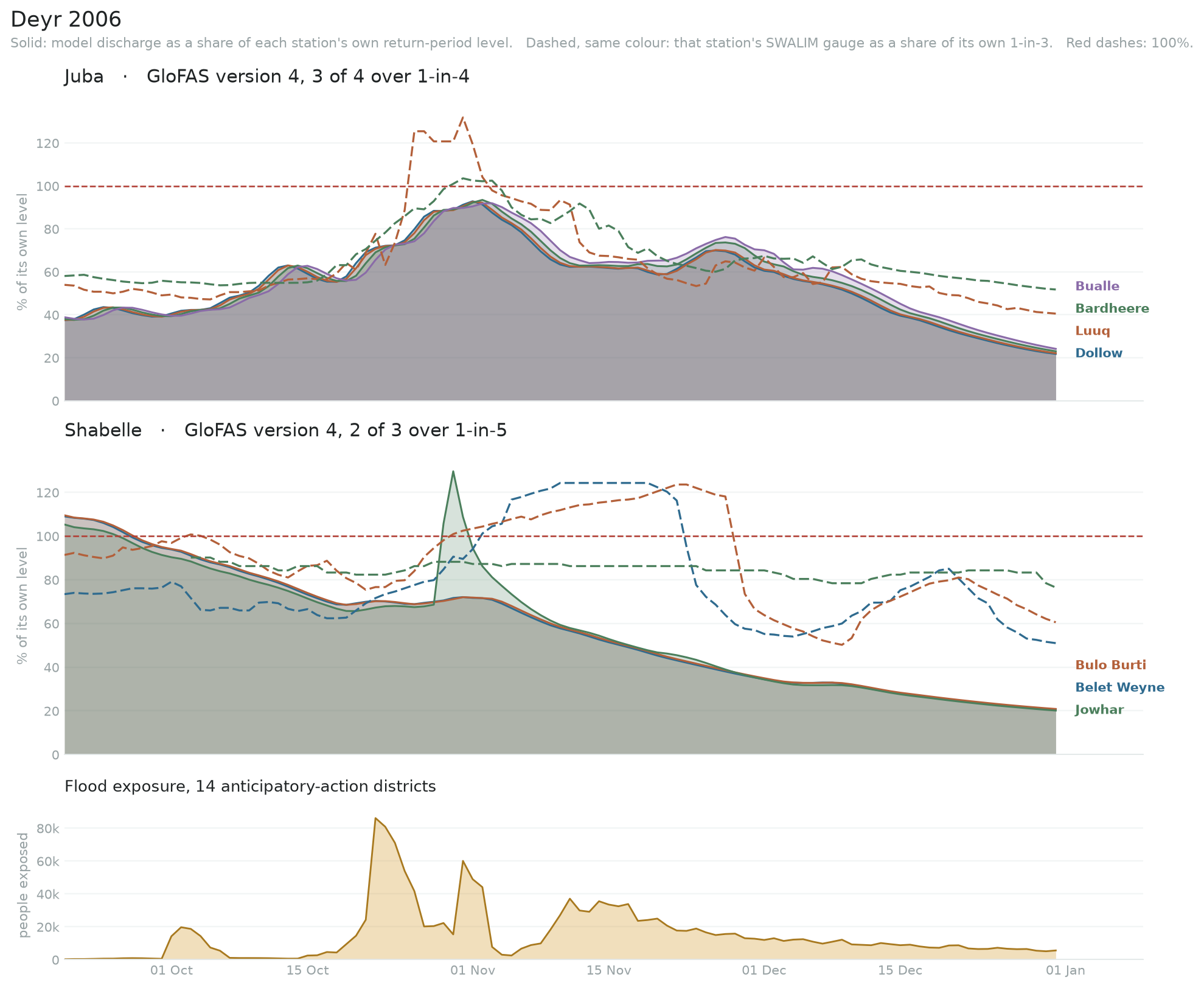
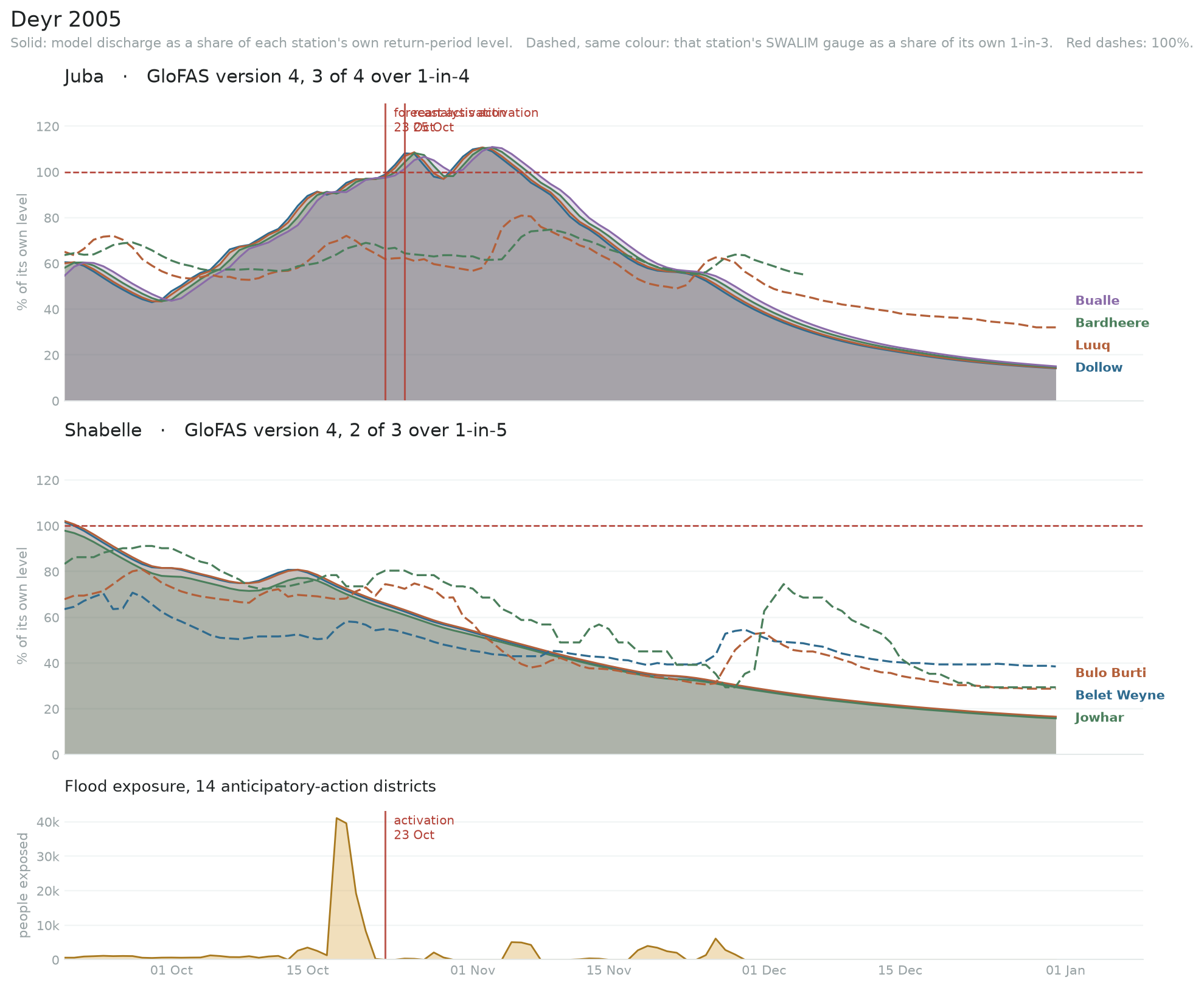
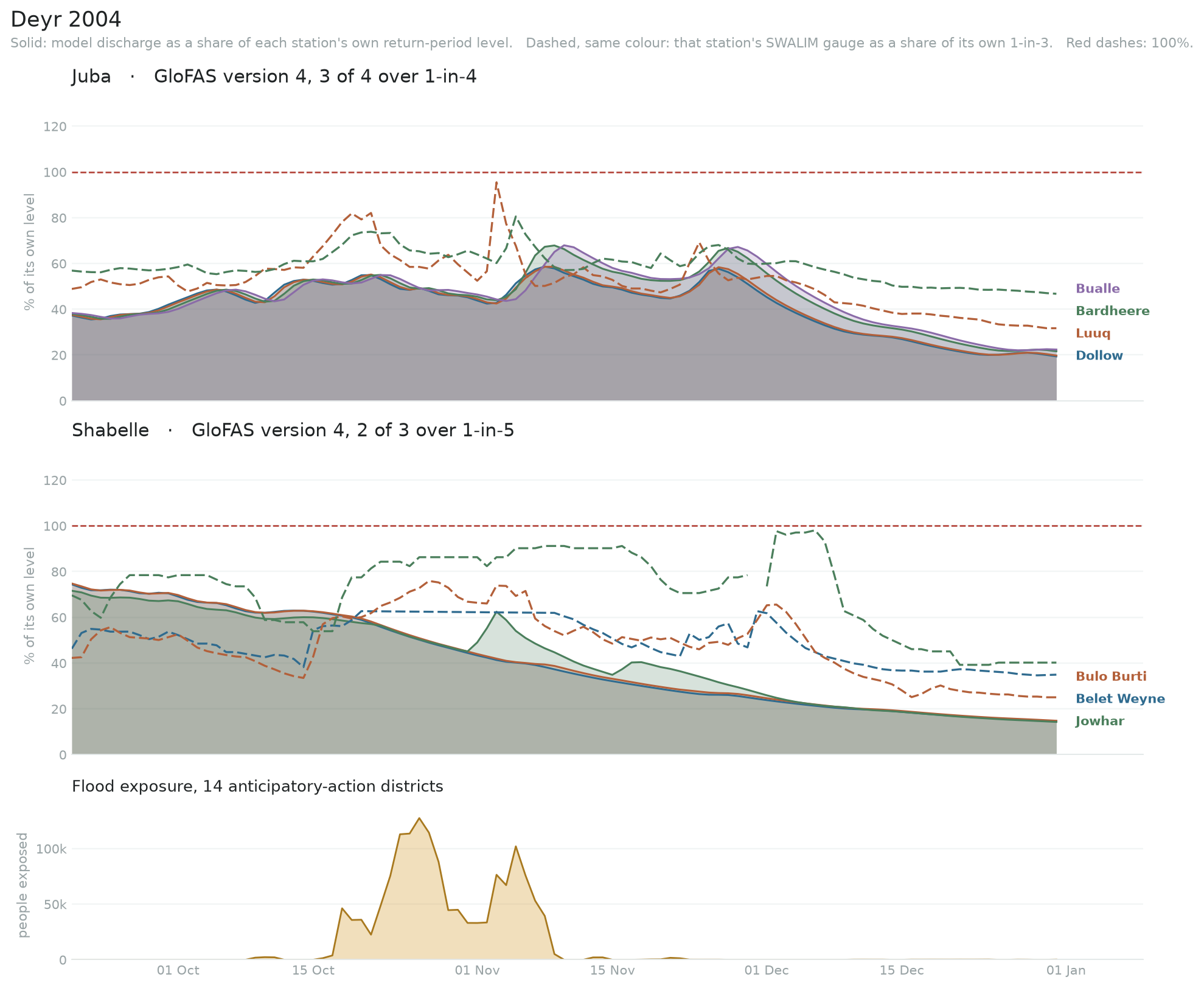
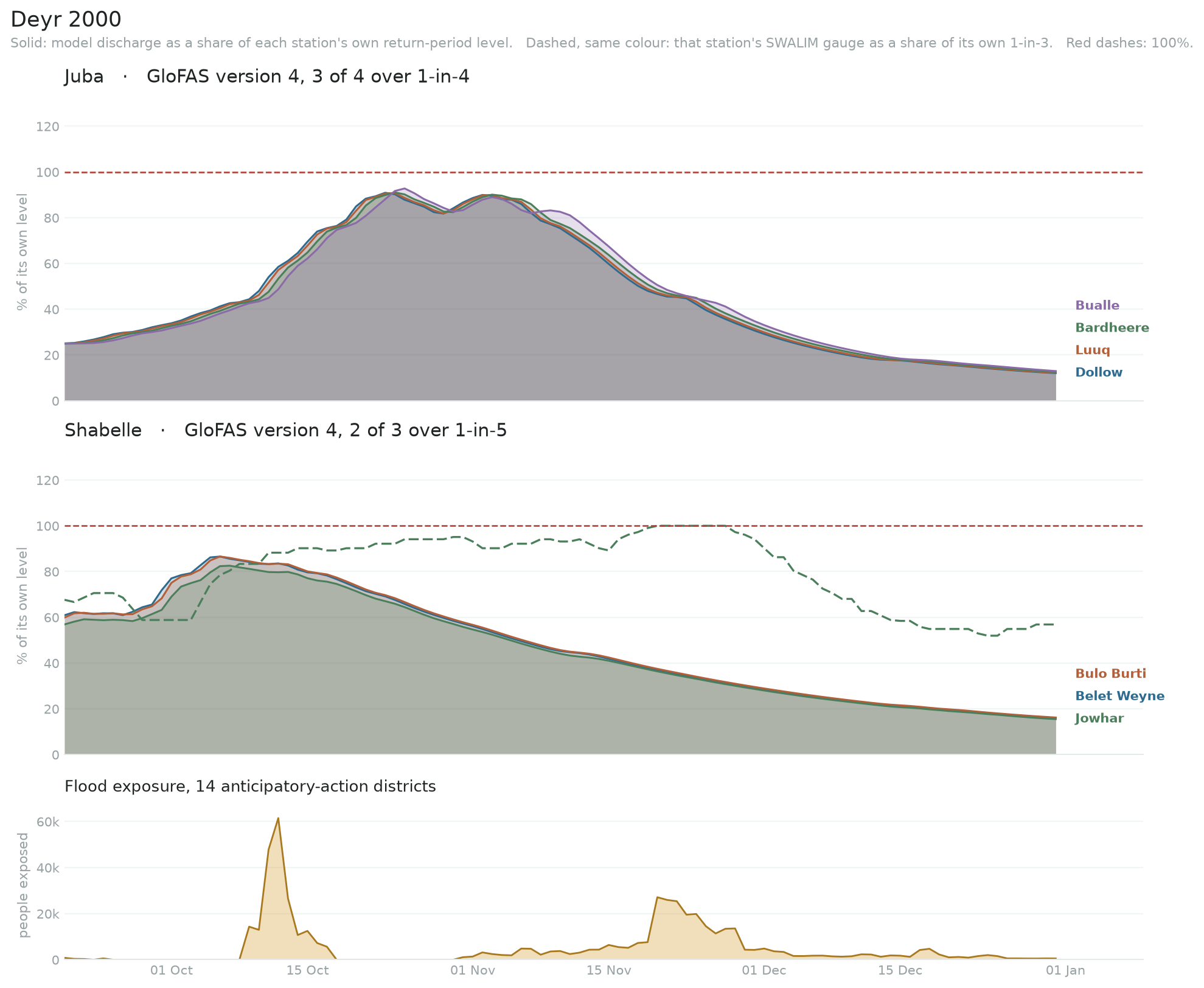
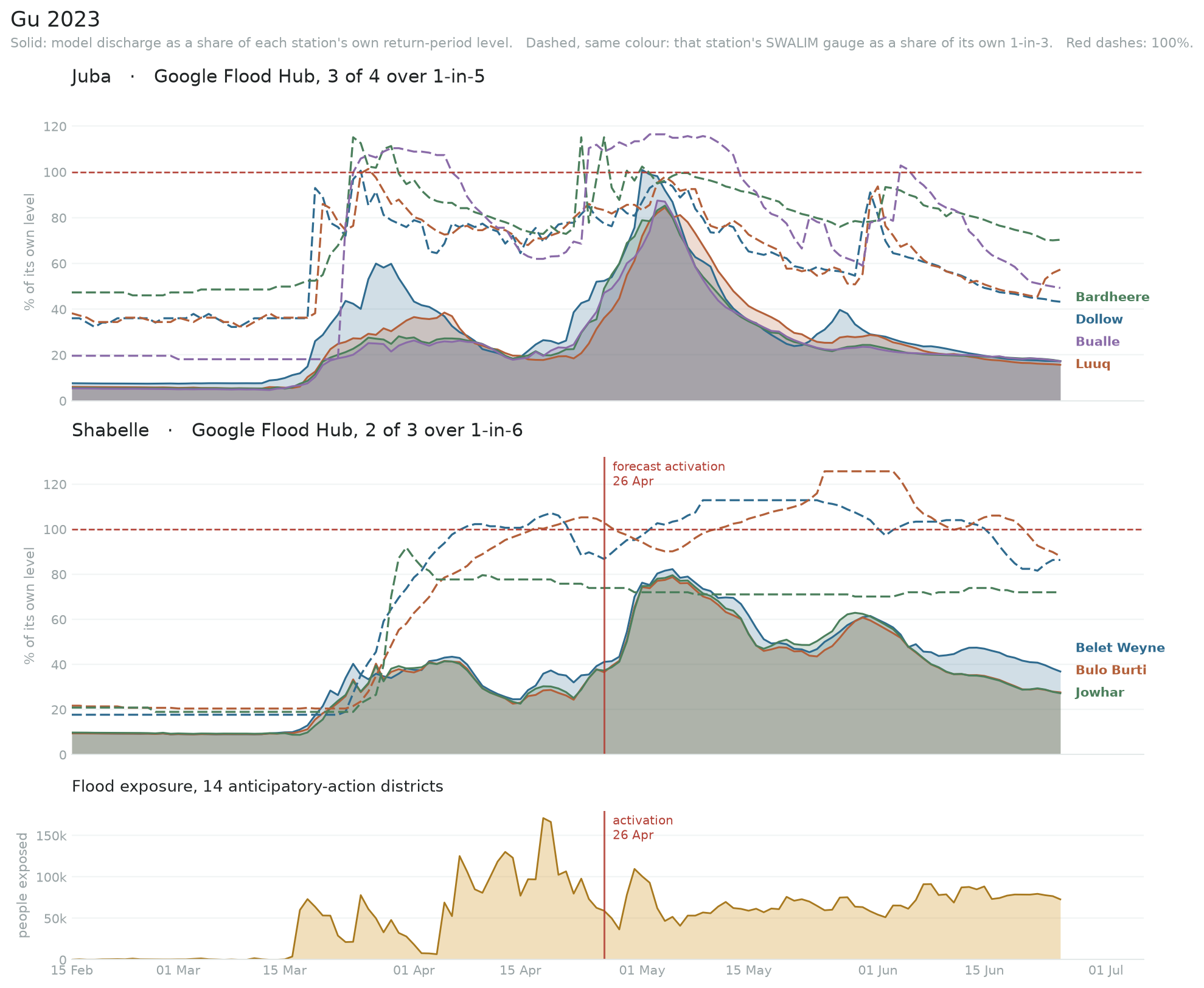
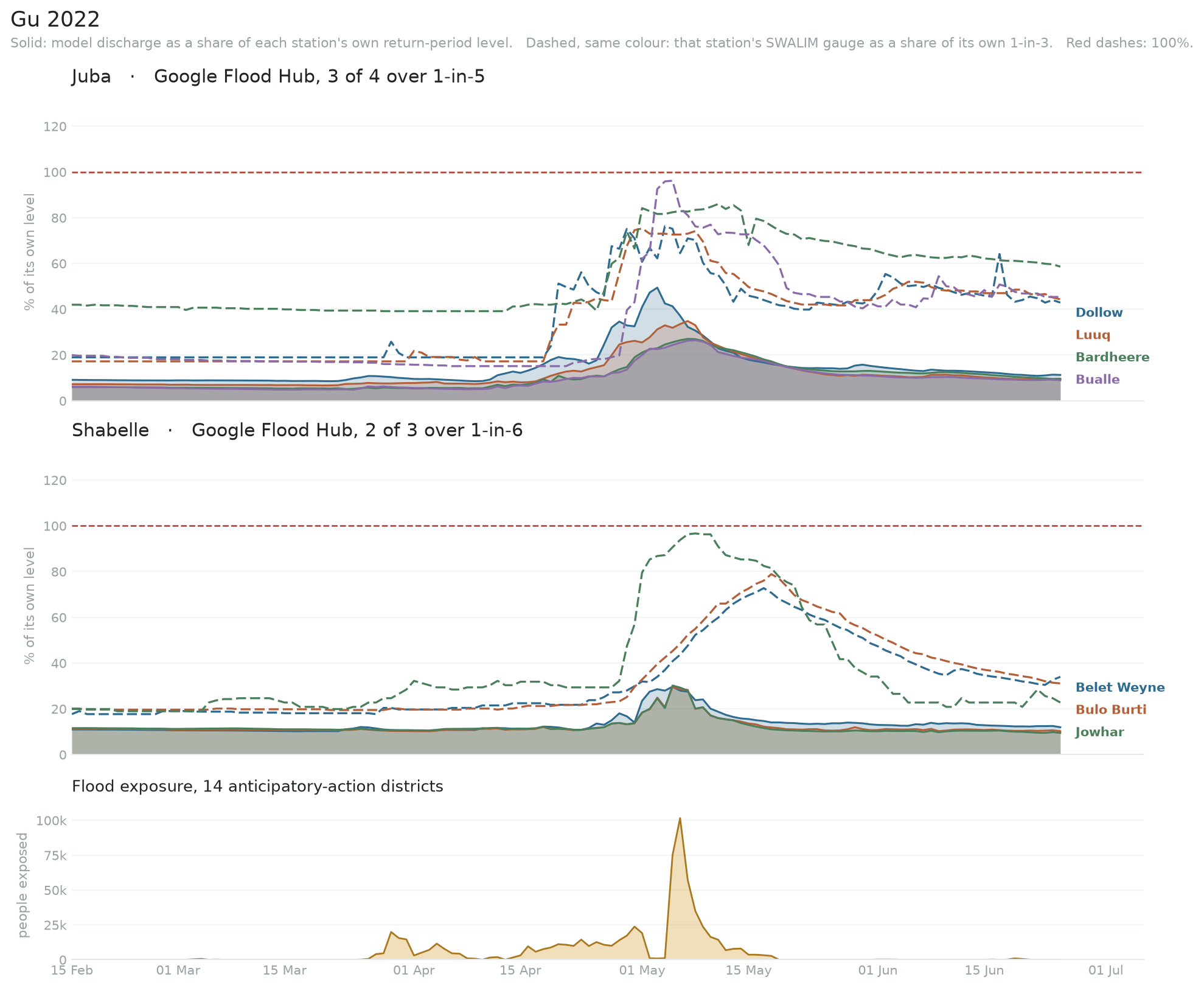
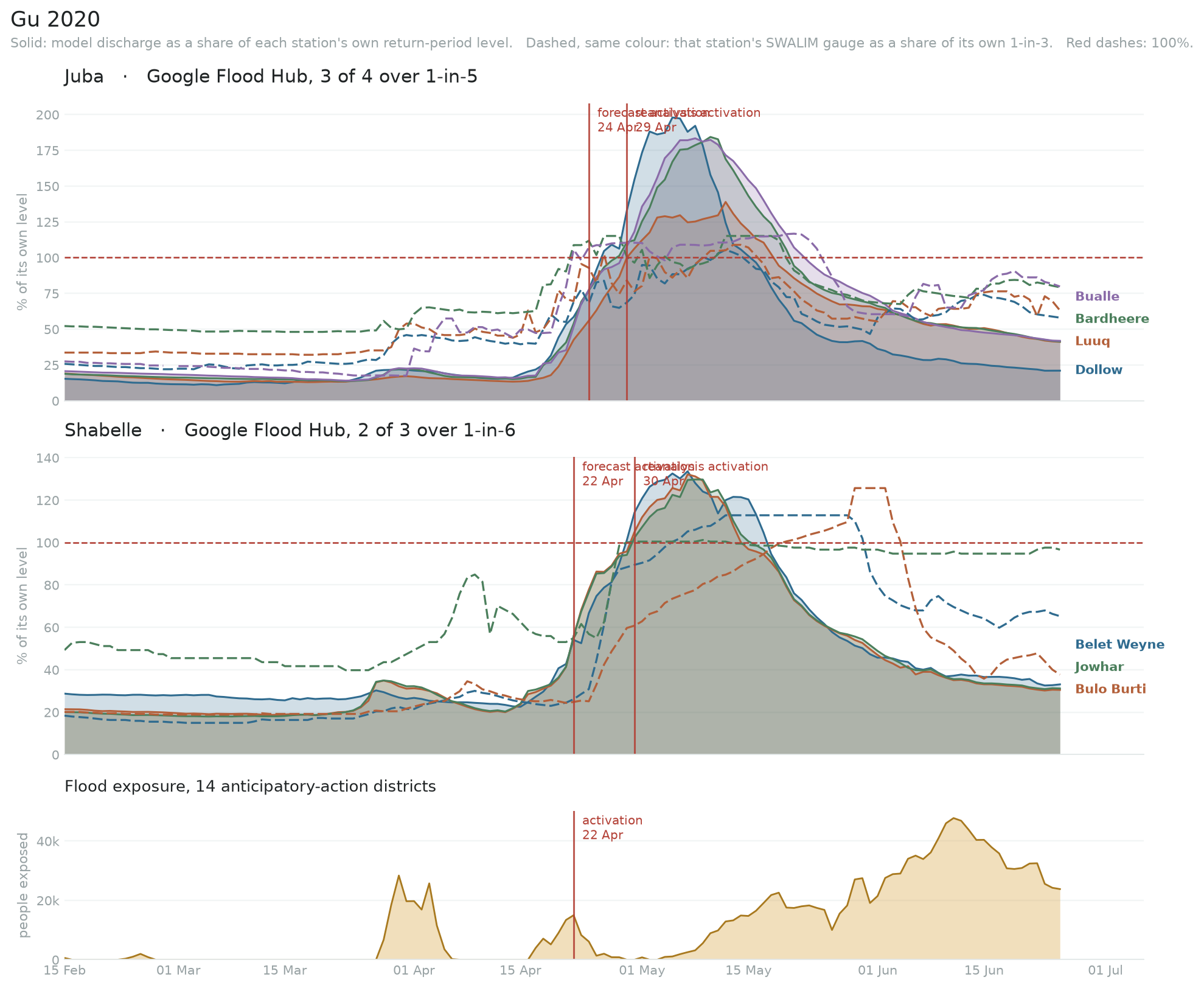
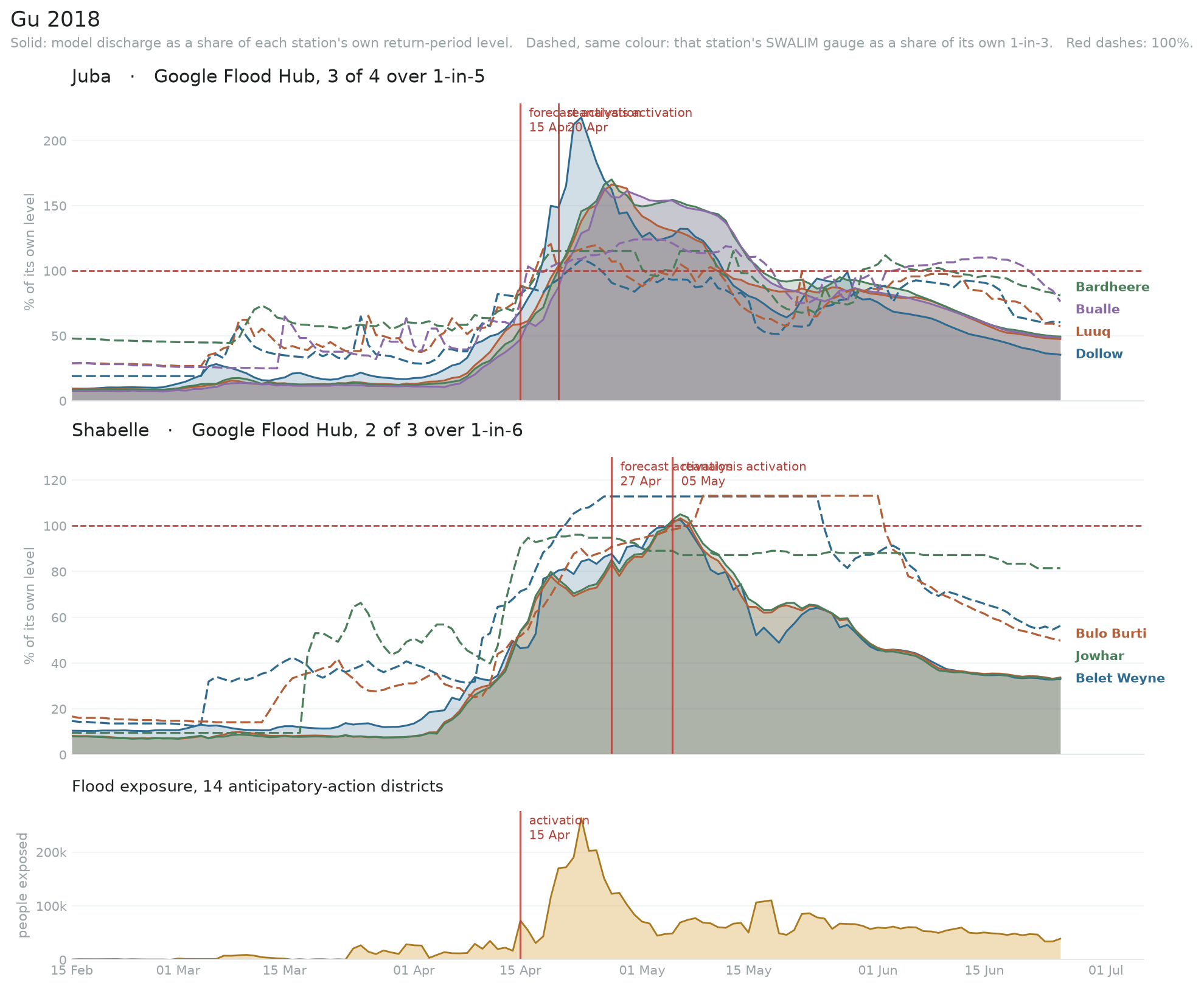
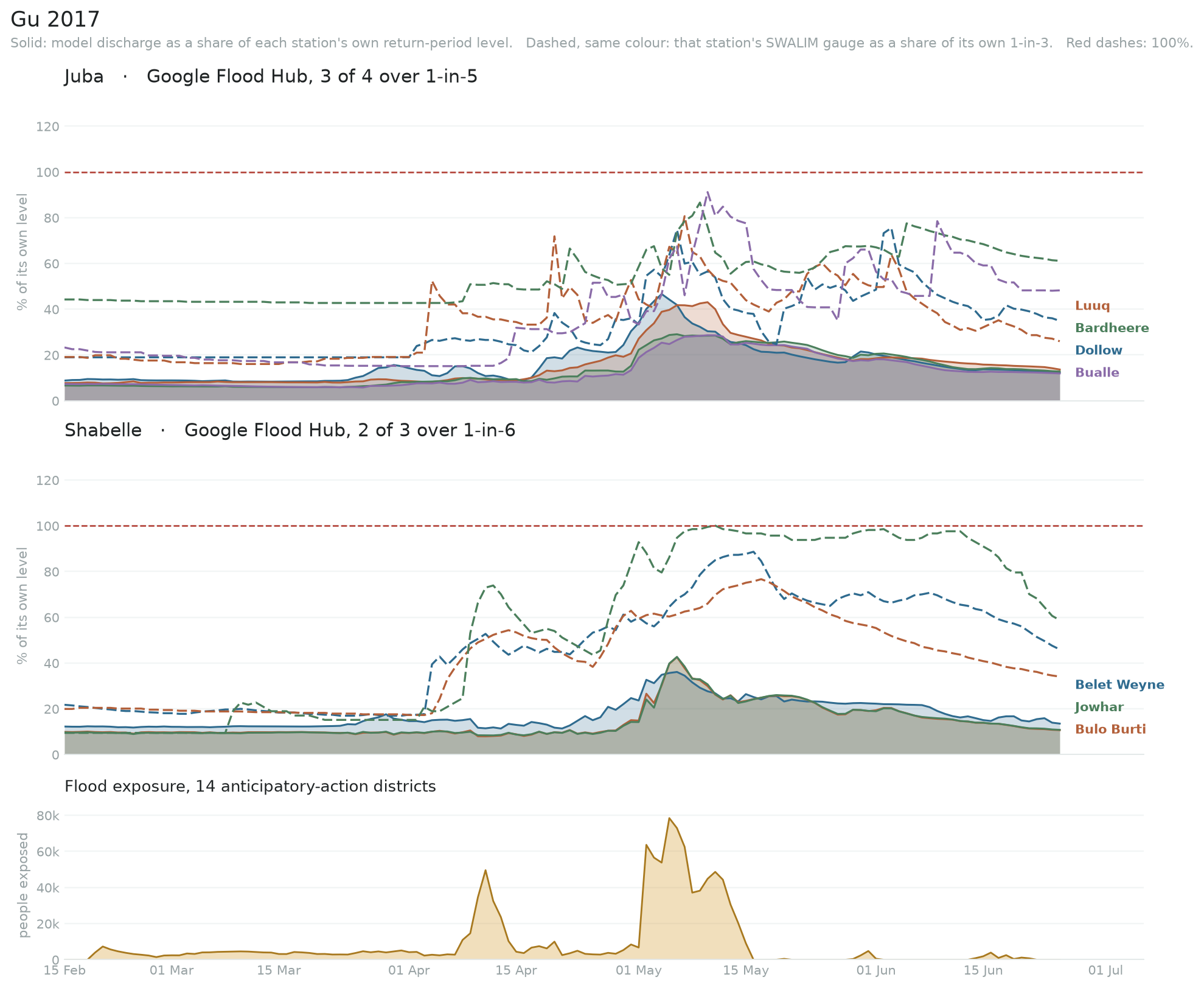
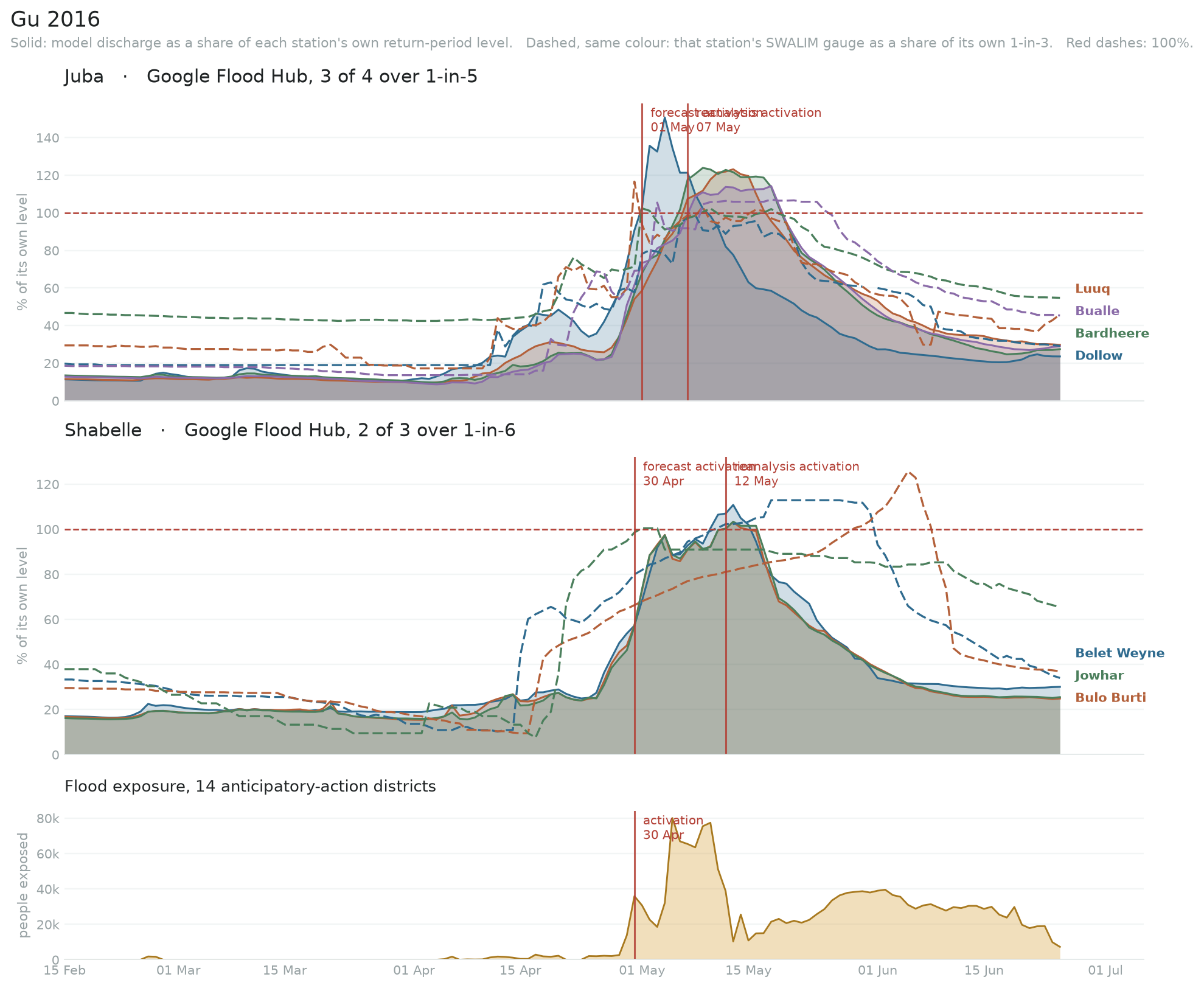
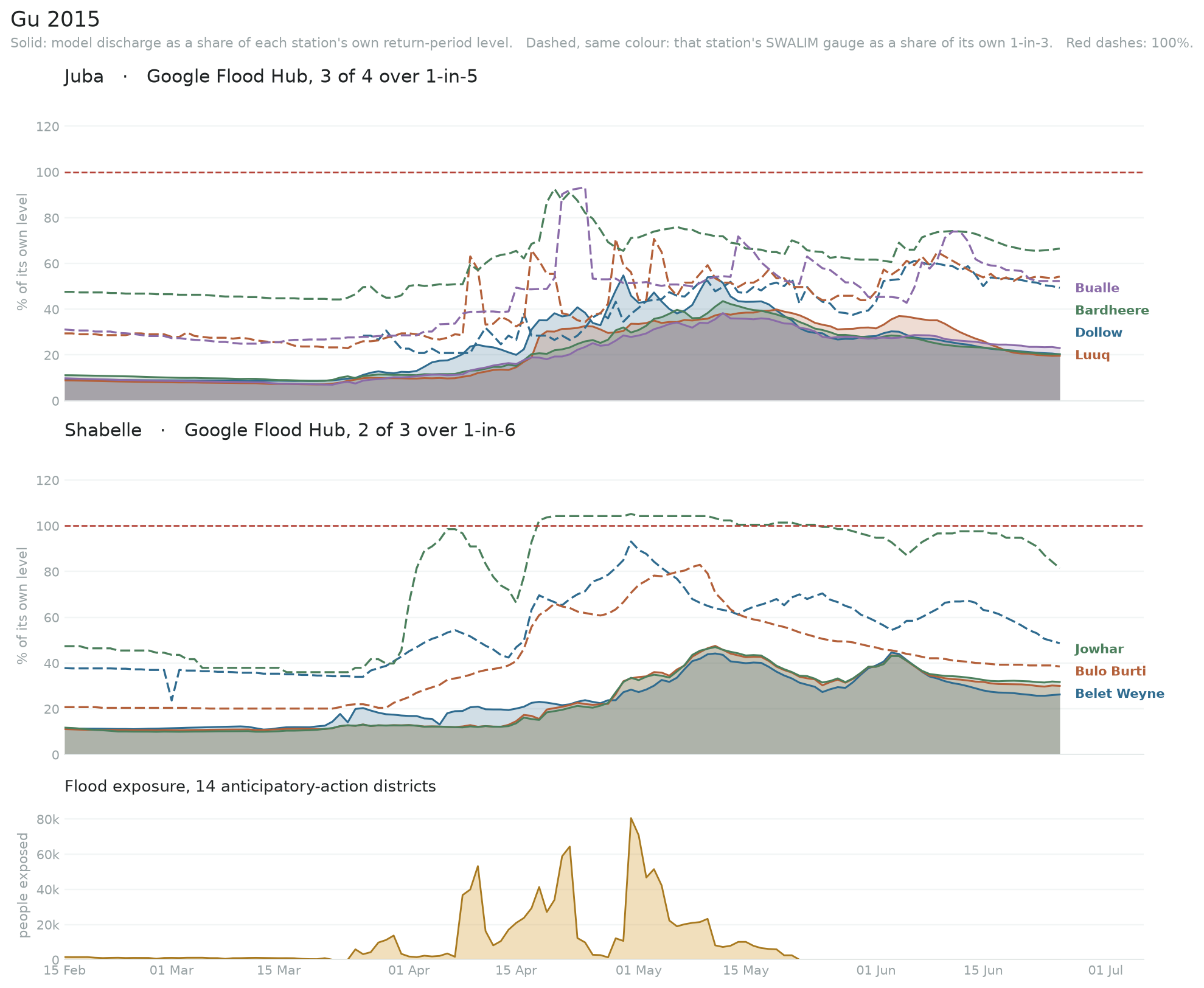
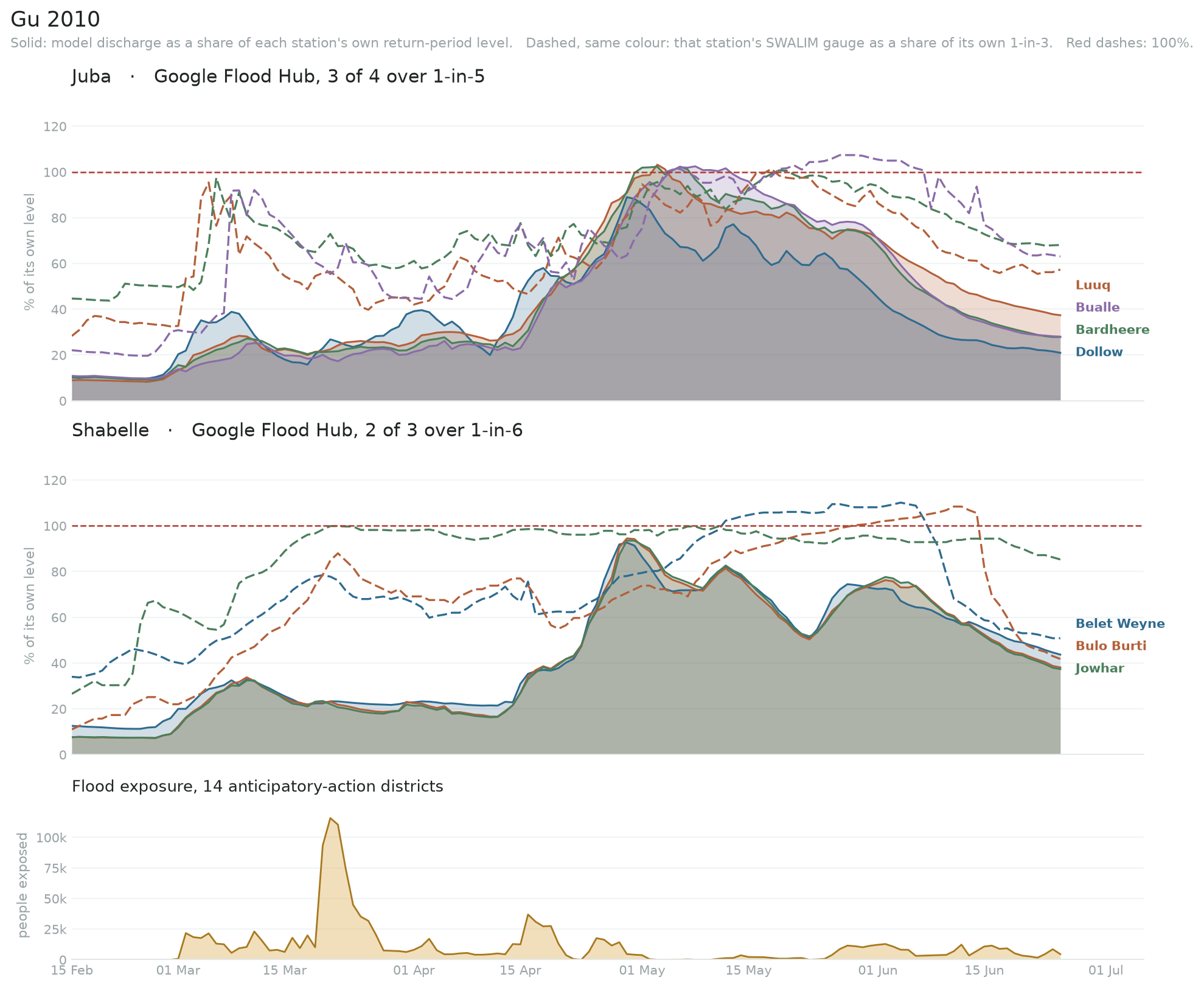
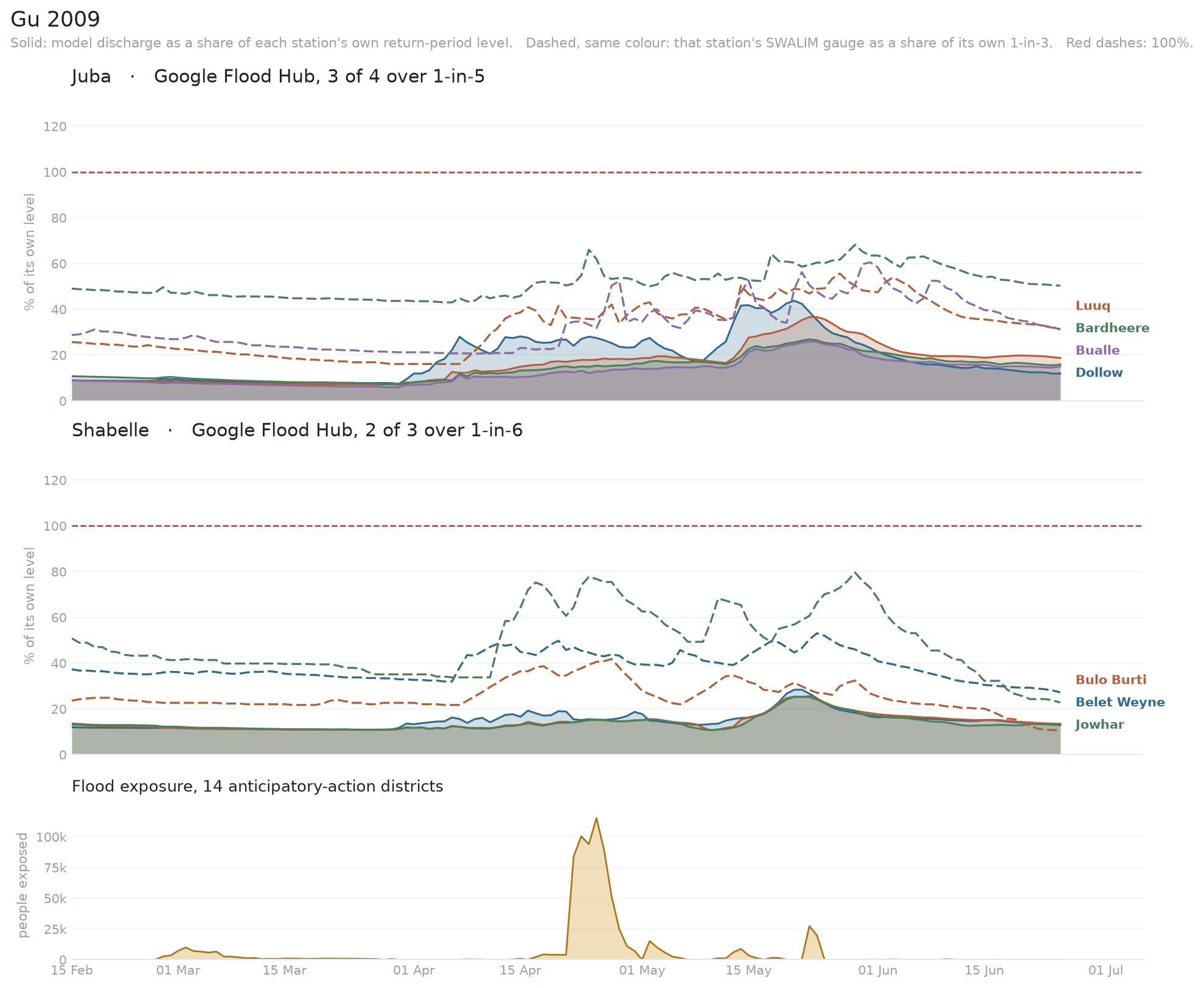
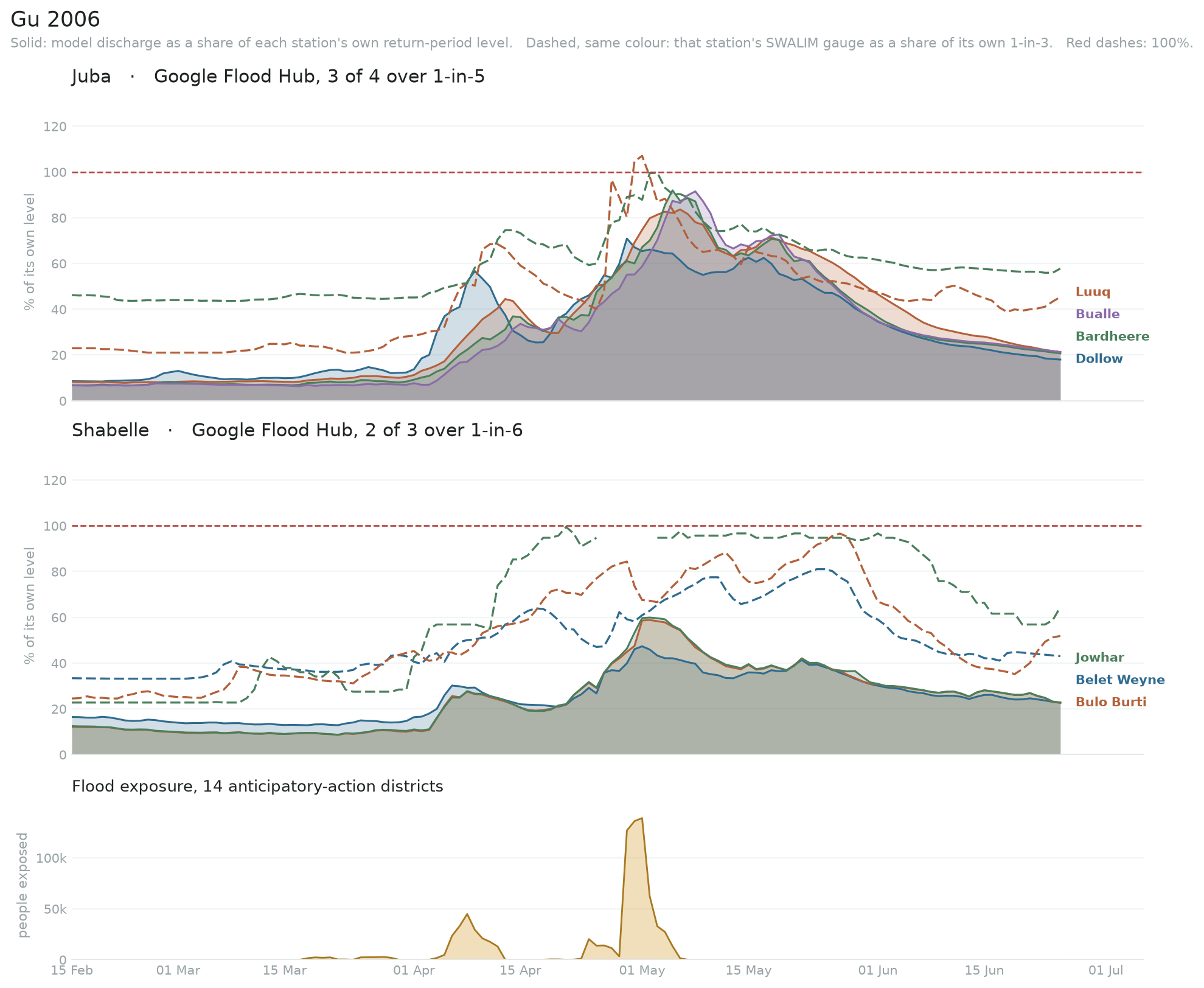
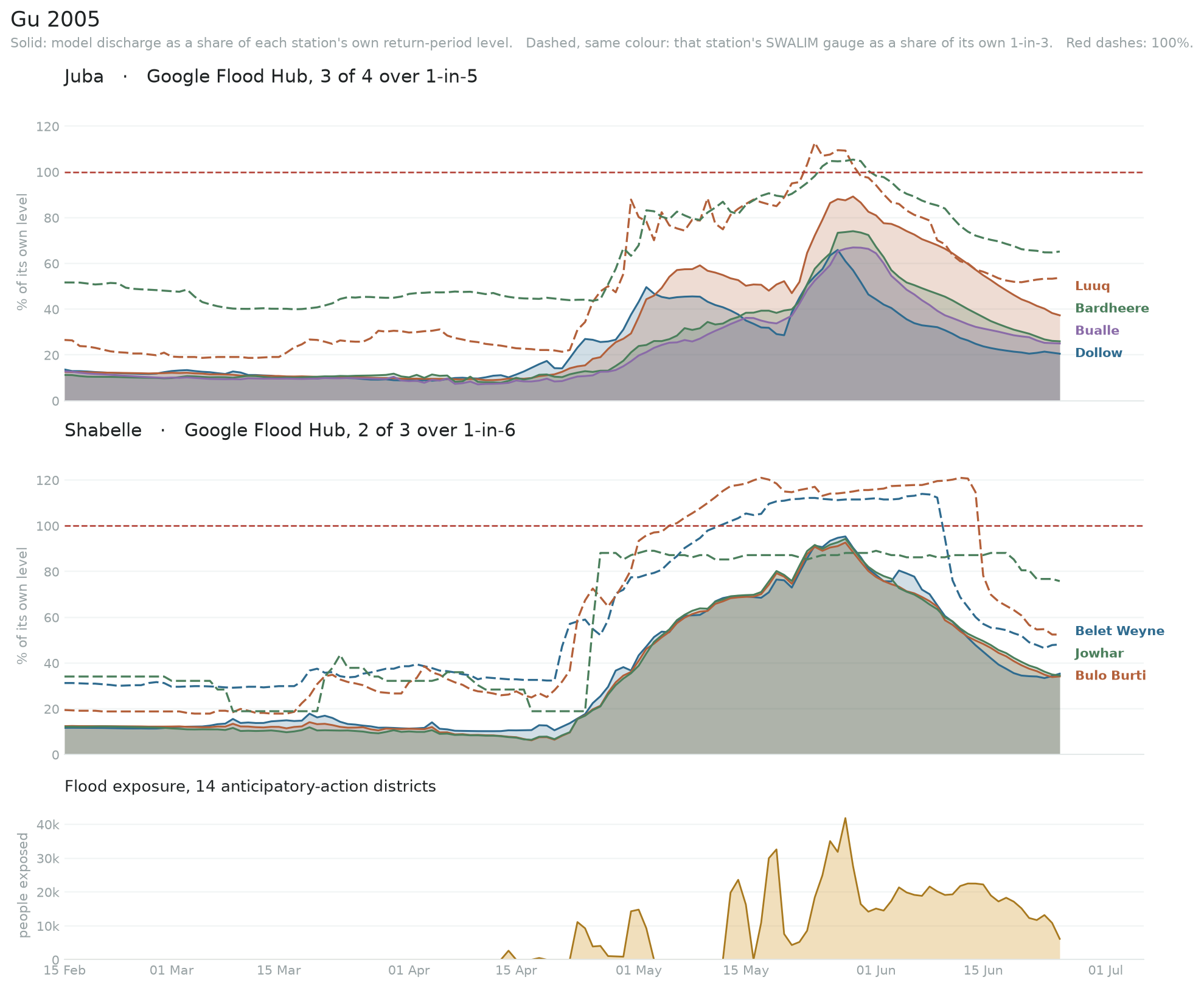
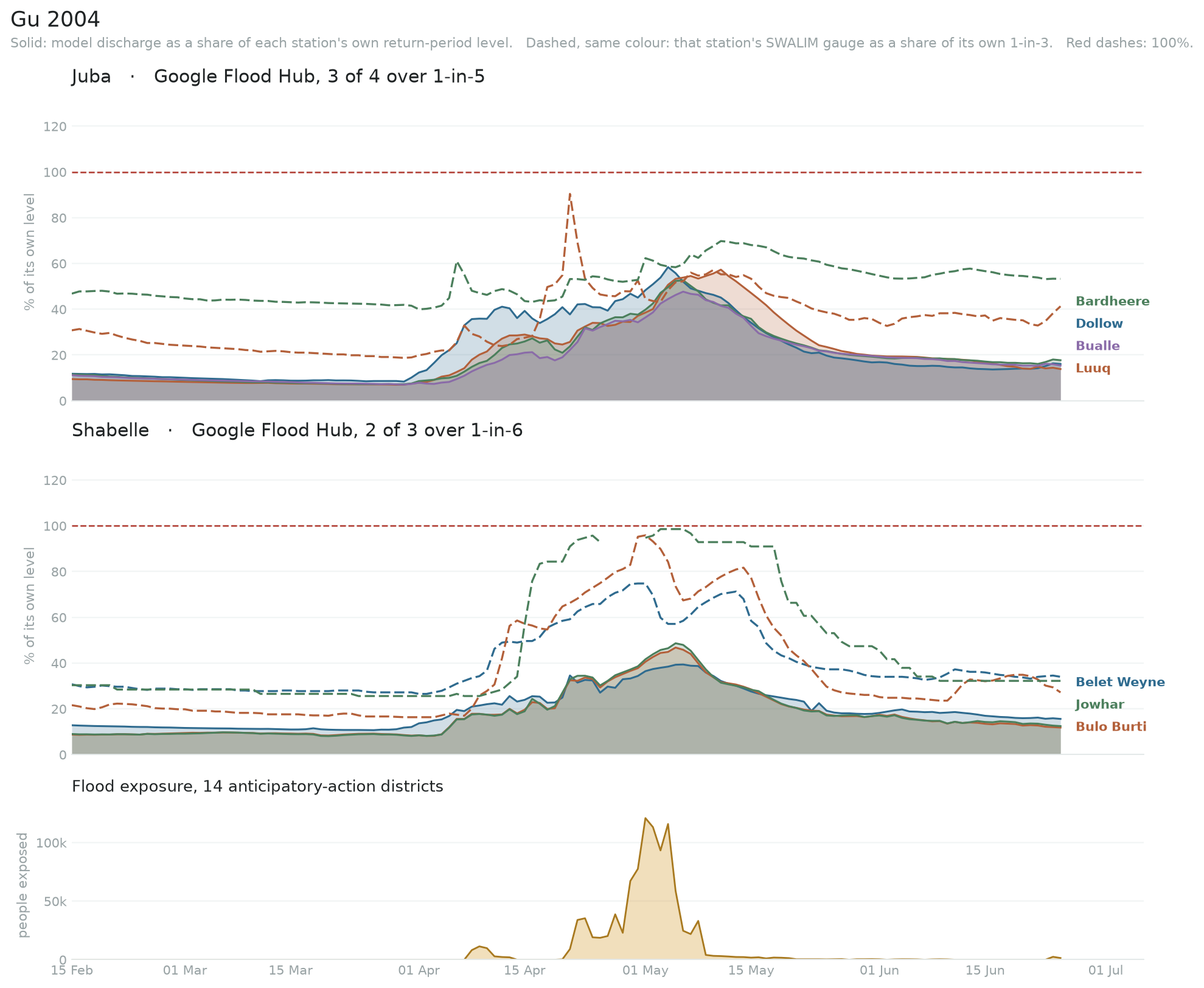
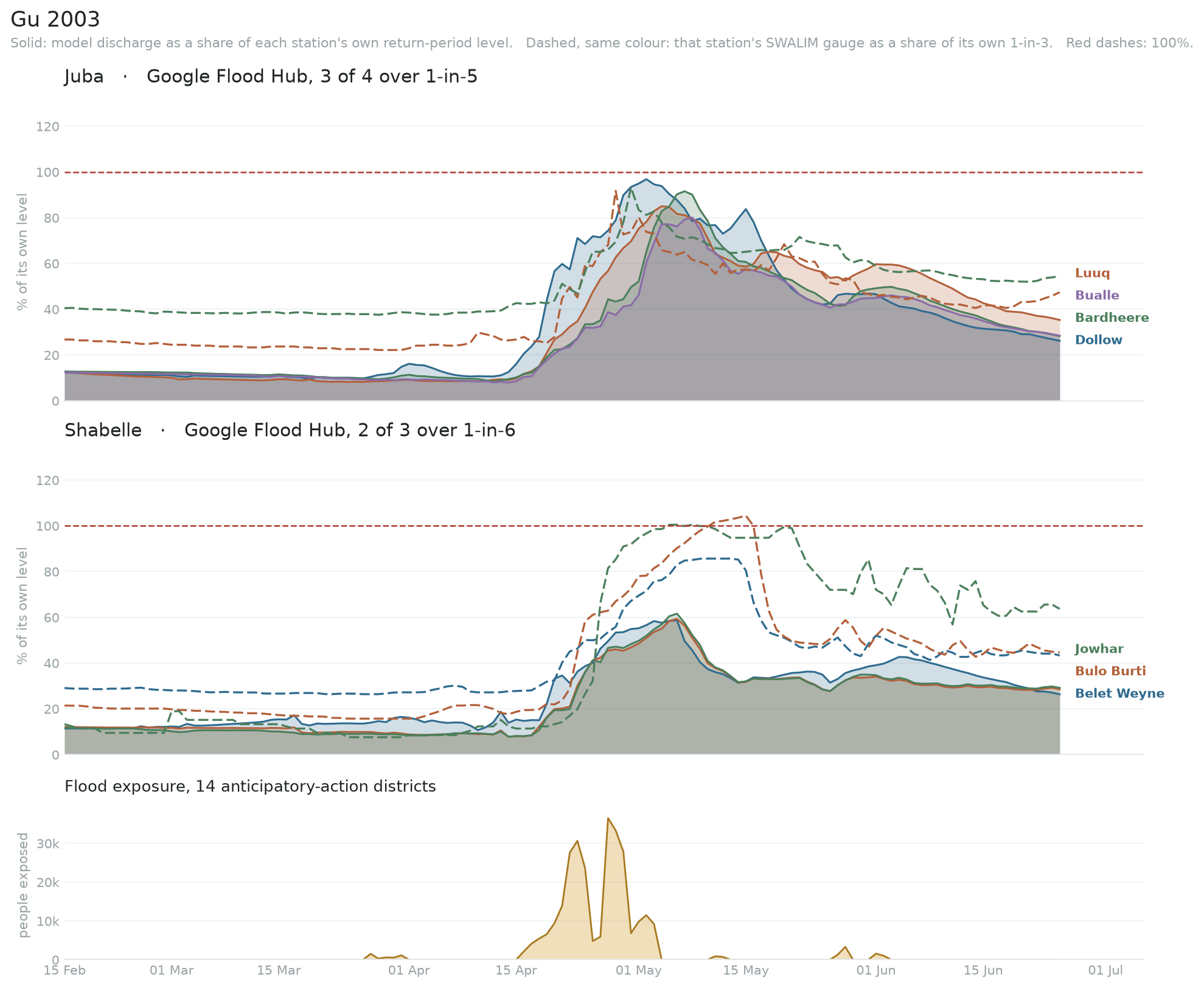
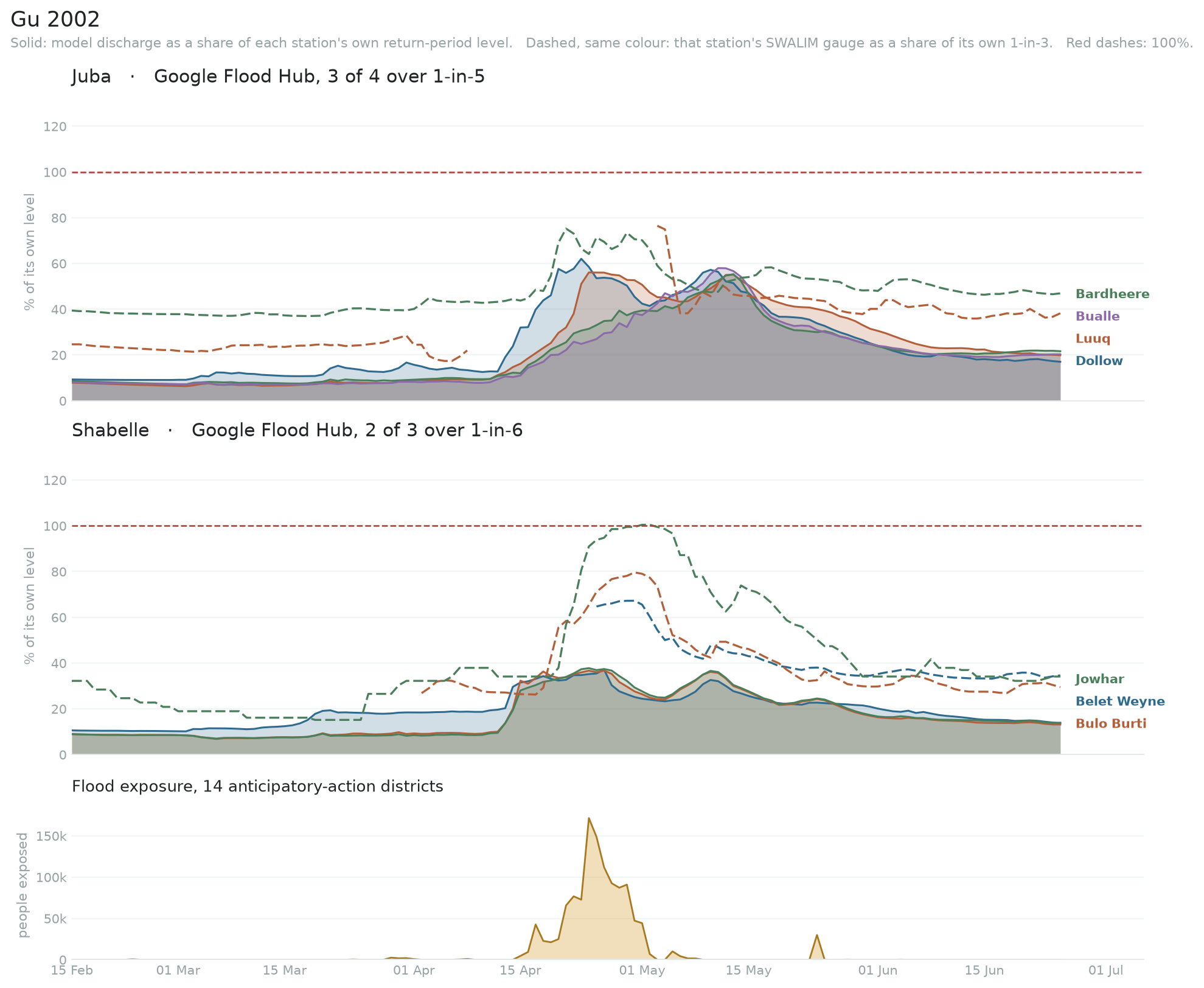
How to read the charts. Filled areas are the window's own activation source, each station as a share of its own return-period level. Lines are the observed SWALIM river levels, each as a share of that gauge's own 1-in-3. The dashed line is 100%, so anything above it is over its own level. The lower panel is flood exposure across the 14 anticipatory-action districts. Red marks the activation.
What each marker is. The forecast date is the first issue on which the activation rule is met at leads 1 to 7 days. The reanalysis date is the first day the same rule is met in the model's historical run. The two-gauge benchmark onset is the day the second gauge on a river reaches its own 1-in-3 level. The three-district level is the day the third of the 14 districts reaches its own 1-in-5 seasonal flood exposure, exposure being FloodScan flood extent combined with WorldPop population, and each district's level fitted by Weibull plotting position on its own seasonal maxima.
Reading the exposure panel. FloodScan derives flood extent from satellite observations, and single-day spikes that fall back immediately can occur. Exposure sustained over several days is the more reliable signal.
Deyr
Activation reads GloFAS version 4 at leads 1 to 7 days, three of four points on the Juba against its own 1-in-4 and two of three on the Shabelle against its own 1-in-5. Forecast archive: 2003 to 2023, about two issues a week.
The Deyr rules were calibrated on the GloFAS version 5 reanalysis, and the operational system has been version 4 since July 2023. The dates here are the version 4 ones, which is what the live system reads, so the count of Deyr activations differs from the trigger summary, which reports the version 5 figures. GloFAS version switch sets out the difference.
Seasons shown: 17, of which 16 have a forecast archive. The trigger is met in 9. The three-district level is reached in 12, and in 5 of those the trigger is also met. Median days from the trigger being met to that date: +13 d. To the second gauge reaching its 1-in-3: +10 d.
Deyr 2023
- Activation
- Juba 21 Oct
- Two-gauge benchmark onset
- Juba 25 Oct, Shabelle 06 Nov
Deyr 2022
- Activation
- no activation
- Two-gauge benchmark onset
- fewer than two gauges crossed
Deyr 2021
- Activation
- no activation
- Two-gauge benchmark onset
- fewer than two gauges crossed
Deyr 2020
- Activation
- Shabelle 02 Oct
- Two-gauge benchmark onset
- Shabelle 01 Oct
Deyr 2019
- Activation
- Shabelle 02 Oct
- Two-gauge benchmark onset
- Shabelle 14 Oct
Deyr 2017
- Activation
- Juba 19 Oct
- Two-gauge benchmark onset
- Juba 07 Nov
Deyr 2016
- Activation
- no activation
- Two-gauge benchmark onset
- fewer than two gauges crossed
Deyr 2015
- Activation
- Juba 23 Oct
- Two-gauge benchmark onset
- fewer than two gauges crossed
Deyr 2014
- Activation
- Juba 23 Oct, Shabelle 12 Oct
- Two-gauge benchmark onset
- Juba 22 Oct, Shabelle 20 Oct
Deyr 2013
- Activation
- Shabelle 07 Oct
- Two-gauge benchmark onset
- fewer than two gauges crossed
Deyr 2011
- Activation
- no activation
- Two-gauge benchmark onset
- fewer than two gauges crossed
Deyr 2010
- Activation
- Shabelle 02 Oct
- Two-gauge benchmark onset
- fewer than two gauges crossed
Deyr 2008
- Activation
- no activation
- Two-gauge benchmark onset
- Juba 15 Nov, Shabelle 20 Nov
Deyr 2006
- Activation
- no activation
- Two-gauge benchmark onset
- Juba 30 Oct, Shabelle 02 Nov
Deyr 2005
- Activation
- Juba 23 Oct
- Two-gauge benchmark onset
- fewer than two gauges crossed
Deyr 2004
- Activation
- no activation
- Two-gauge benchmark onset
- fewer than two gauges crossed
Deyr 2000
- Activation
- no activation
- Two-gauge benchmark onset
- fewer than two gauges crossed
Gu
Activation reads Google Flood Hub at leads 1 to 7 days, three of four points on the Juba against its own 1-in-5 and two of three on the Shabelle against its own 1-in-6. Forecast archive: 2016 to 2023, daily, so seasons before 2016 show the reanalysis, gauges and exposure only.
Seasons shown: 15, of which 6 have a forecast archive. The trigger is met in 4. The three-district level is reached in 11, and in 3 of those the trigger is also met. Median days from the trigger being met to that date: +0 d. To the second gauge reaching its 1-in-3: +0 d.
Gu 2023
- Activation
- Shabelle 26 Apr
- Two-gauge benchmark onset
- Juba 25 Mar, Shabelle 17 Apr
Gu 2022
- Activation
- no activation
- Two-gauge benchmark onset
- fewer than two gauges crossed
Gu 2020
- Activation
- Juba 24 Apr, Shabelle 22 Apr
- Two-gauge benchmark onset
- Juba 22 Apr, Shabelle 05 May
Gu 2018
- Activation
- Juba 15 Apr, Shabelle 27 Apr
- Two-gauge benchmark onset
- Juba 17 Apr, Shabelle 07 May
Gu 2017
- Activation
- no activation
- Two-gauge benchmark onset
- fewer than two gauges crossed
Gu 2016
- Activation
- Juba 01 May, Shabelle 30 Apr
- Two-gauge benchmark onset
- Juba 01 May, Shabelle 11 May
Gu 2015
- Activation
- no activation
- Two-gauge benchmark onset
- fewer than two gauges crossed
Gu 2010
- Activation
- no activation
- Two-gauge benchmark onset
- Juba 18 May, Shabelle 29 May
Gu 2009
- Activation
- no activation
- Two-gauge benchmark onset
- fewer than two gauges crossed
Gu 2006
- Activation
- no activation
- Two-gauge benchmark onset
- fewer than two gauges crossed
Gu 2005
- Activation
- no activation
- Two-gauge benchmark onset
- Juba 25 May, Shabelle 12 May
Gu 2004
- Activation
- no activation
- Two-gauge benchmark onset
- fewer than two gauges crossed
Gu 2003
- Activation
- no activation
- Two-gauge benchmark onset
- Shabelle 11 May
Gu 2002
- Activation
- no activation
- Two-gauge benchmark onset
- fewer than two gauges crossed
Gu 2001
- Activation
- no activation
- Two-gauge benchmark onset
- fewer than two gauges crossed