Findings
- Four windows, one forecast source each: GloFAS in Deyr and Google Flood Hub in Gu, with thresholds between 1-in-4 and 1-in-6 at each gauge. Any one window activating releases the allocation.
- On the 1999 to 2023 gauge record the mechanism activates 8 times in 25 years (1-in-3.2), catches all 7 severe seasons, and activates once in a year with no gauge flood (2013).
- GloFAS tracks the gauges more closely in Deyr (0.85 against 0.66 for Google) and Google more closely in Gu (0.86 against 0.79); Google also orders the Gu floods closer to the gauges' order.
- On the historical forecasts, Google was first in all 4 Gu seasons both archives cover and GloFAS v4 was first in 2 of 3 in Deyr. The action window stops at 7 days because Google forecasts no further and GloFAS forecasts of high flow are lower beyond a week.
- SWALIM's bulletins were first in 6 of 8 seasons where both flagged. A SWALIM moderate flood risk alert also reaches readiness; counting its alerts in flood seasons, readiness is reached in 10 of the 21 years 2003 to 2023 (1-in-2.2), against 1-in-2.8 on the GloFAS forecast alone. Action needs a rule that can be backtested.
The trigger
The trigger covers two rivers and two rainy seasons, which gives four windows. Each window runs on one forecast source and one rule. If any one window activates, the full allocation is released.
| Window | Season | Source | Rule | Gauges |
|---|---|---|---|---|
| Deyr Juba | October to December | GloFAS | 3 of 4 gauges forecast over their own 1-in-4 level on the same day | Dollow, Luuq, Bardheere, Bualle |
| Deyr Shabelle | October to December | GloFAS | 2 of 3 gauges forecast over their own 1-in-5 level on the same day | Belet Weyne, Bulo Burti, Jowhar |
| Gu Juba | March to May | Google Flood Hub | 3 of 4 gauges forecast over their own 1-in-5 level on the same day | Dollow, Luuq, Bardheere, Bualle |
| Gu Shabelle | March to May | Google Flood Hub | 2 of 3 gauges forecast over their own 1-in-6 level on the same day | Belet Weyne, Bulo Burti, Jowhar |
Readiness activates 8 to 12 days ahead and releases the mobilisation share. It is reached in either of two ways: the GloFAS ensemble median forecast meets the window's rule at those leads, against the same gauge levels as the action leg with the return period capped at 1-in-5; or SWALIM issues a moderate flood risk alert for either river. Action activates 1 to 7 days ahead and releases the rest. Thresholds are fitted on each source's own record.
| Window | Readiness rule, GloFAS forecast | Years reached, 2003 to 2023 |
|---|---|---|
| Deyr Juba | 3 of 4 gauges forecast over their own 1-in-4 level on the same day, 8 to 12 days ahead | 2017, 2023 |
| Deyr Shabelle | 2 of 3 gauges forecast over their own 1-in-5 level on the same day, 8 to 12 days ahead | 2013, 2019 |
| Gu Juba | 3 of 4 gauges forecast over their own 1-in-5 level on the same day, 8 to 12 days ahead | 2020 |
| Gu Shabelle | 2 of 3 gauges forecast over their own 1-in-5 level on the same day, 8 to 12 days ahead | 2005, 2010, 2016 |
| Readiness, GloFAS forecast | Readiness, GloFAS forecast or SWALIM alert | Action |
|---|---|---|
| 1-in-2.8 | 1-in-2.2 | 1-in-3.2 |
Return periods of the trigger, Weibull (years + 1) over activations. Action: 8 activations in 25 years, 1999 to 2023. Readiness on the GloFAS forecast: 8 activations in the 21 years of forecast archive at leads 8 to 12, 2003 to 2023 (2005, 2010, 2013, 2016, 2017, 2019, 2020, 2023). Readiness on either route: 10 of the same 21 years (2005, 2006, 2010, 2013, 2014, 2016, 2017, 2019, 2020, 2023); the SWALIM route counts a moderate or higher flood risk bulletin in a season the two-gauge benchmark calls a flood, which adds 2006, 2014. SWALIM also issued such bulletins in seasons without a two-gauge flood; the years those would add, 2007, 2009, 2011, 2012, 2015, 2021, are not counted.
Why action stops at 7 days. Google Flood Hub, the Gu source, forecasts 7 days ahead and no further. GloFAS forecasts run longer, but the ensemble's high flows are lower at longer lead times. By day 7 they are about 11 per cent below the day-1 forecast, and by day 12 about 24 per cent below. On the GloFAS v4 reforecast run on all four windows over the 21 years its archive covers at both bands, 2003 to 2023, the rule activated in 11 years at 1 to 7 days and in 7 years at 8 to 12 days; it caught 6 of the 7 severe years at 1 to 7 days and 4 at 8 to 12 days. Days 8 to 12 are used for readiness rather than action.
What counts as a flood
The trigger is scored against the SWALIM gauge record. A river has a flood season when two of its gauges reach their own 1-in-3 level, and a severe season when two reach their 1-in-5 level. Each gauge's levels are fitted on its own record from 2000 to 2023.
| First to second gauge, median | |||||
|---|---|---|---|---|---|
| Window | Flood seasons | Severe | Severe years | Over 1-in-3 | Over 1-in-5 |
| Deyr Juba | 5 | 3 | 2006, 2014, 2023 | 5 days | 4 days |
| Deyr Shabelle | 6 | 5 | 2006, 2014, 2019, 2020, 2023 | 16 days | 8 days |
| Gu Juba | 6 | 3 | 2018, 2020, 2023 | 1 day | 20 days |
| Gu Shabelle | 7 | 3 | 2016, 2020, 2023 | 9 days | 12 days |
Across both rivers there are 12 flood years, of which 7 are severe. Gauges are capped at bank full, so the largest floods record the same reading. A season in which only one gauge crosses does not count, as in Gu 2021 at Belet Weyne. The flood is dated from the day the second gauge crosses; the last two columns give the median number of days by which the river's first gauge crossed earlier.
Which source, and why
Three global models were considered. GEOGloWS runs 4 to 10 times too high on the Shabelle and has no forecast archive, and was not taken further. Google Flood Hub and GloFAS were compared with the SWALIM gauges on their own records of the past, Google's retrospective run and GloFAS's version 5 reanalysis, using only the seasons in which the gauge reached its own 1-in-3 level between 2000 and 2023 (2 to 10 seasons per gauge). Both measures are Spearman correlations, which compare ranks rather than raw values, and both are shown as the median across the river's gauges; ranking needs at least four seasons, which leaves Dollow out of it.
- Tracking correlates the model's daily flow with the gauge's daily level over every day of those seasons, allowing the model to run ahead of or behind the gauge (the best fit was within ten days for every gauge). A value of 1 means the model rises and falls exactly with the gauge, and 0 means no relation.
- Ranking correlates how high the model went in each of those seasons with how high the gauge went. It tests whether the model orders the floods by size as the gauge did. A value of 1 means the same order, 0 means no relation, and a value below 0 means the wrong order.
| Tracking | Ranking | ||||
|---|---|---|---|---|---|
| Window | Google Flood Hub | GloFAS | Google Flood Hub | GloFAS | Chosen |
| Deyr Juba | 0.66 | 0.85 | 0.36 | 0.32 | GloFAS |
| Deyr Shabelle | 0.66 | 0.85 | 0.67 | 0.77 | GloFAS |
| Deyr, both rivers | 0.66 | 0.85 | 0.62 | 0.62 | GloFAS |
| Gu Juba | 0.87 | 0.83 | 0.50 | -0.48 | Google Flood Hub |
| Gu Shabelle | 0.78 | 0.79 | 0.08 | 0.04 | Google Flood Hub |
| Gu, both rivers | 0.86 | 0.79 | 0.20 | -0.03 | Google Flood Hub |
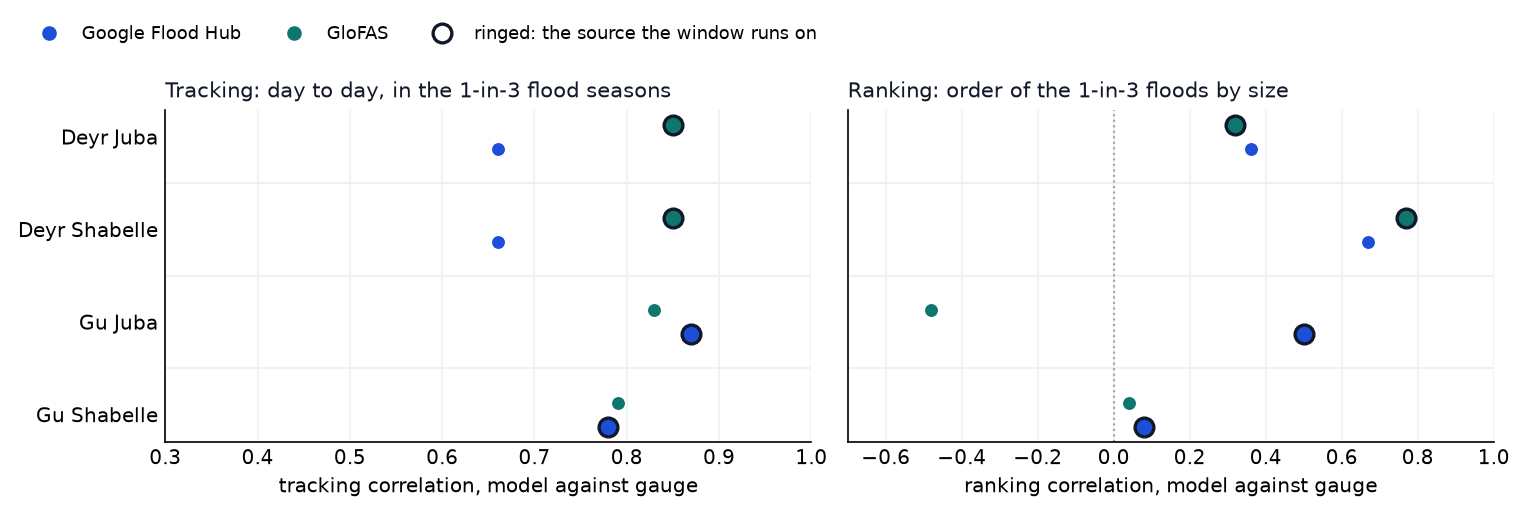
In Deyr, GloFAS tracks the gauges more closely than Google (0.85 against 0.66). Google also over-activates in Deyr, with three Juba activations in years with no flood, and misses the Shabelle in 2020. In Gu, Google tracks more closely on the Juba and level with GloFAS on the Shabelle, orders the floods closer to the gauges' order, and its forecasts went out before the flood where GloFAS v4's mostly went out after it, as the next section shows. Gu Shabelle reads near zero on ranking for every model because the gauge is capped at bank full in the largest floods.
How often it activates
Every threshold sits at 1-in-3 or rarer. The vote counts were set so that the mechanism as a whole activates about once in three years while still catching every severe season.
| Activations, 25 years | Return period | Years | |
|---|---|---|---|
| Deyr Juba | 2 | 1-in-13.0 | 2006, 2023 |
| Deyr Shabelle | 4 | 1-in-6.5 | 2006, 2014, 2019, 2023 |
| Gu Juba | 4 | 1-in-6.5 | 2013, 2016, 2018, 2020 |
| Gu Shabelle | 4 | 1-in-6.5 | 2013, 2016, 2018, 2020 |
| Deyr, either window | 4 | 1-in-6.5 | 2006, 2014, 2019, 2023 |
| Gu, either window | 4 | 1-in-6.5 | 2013, 2016, 2018, 2020 |
| Whole mechanism | 8 | 1-in-3.2 | 2006, 2013, 2014, 2016, 2018, 2019, 2020, 2023 |
Activations, impact and response, year by year, as on the analysis page. The trigger column is the peak number of monitored points over their thresholds at the same time that season, filled red where the window activates. RP is the gauge benchmark above: 5yr where two of the river's gauges reached their own 1-in-5 level that season, 3yr where two reached 1-in-3 but not 1-in-5. The table fits each gauge's levels on its record from 2000 to its last reading, which runs into 2024 for some gauges, where the rest of this page stops at 2023; the two differ in one cell, Deyr Juba 2008, 5yr here and 1-in-3 above. EM-DAT is people affected and CERF the allocation from the UN Central Emergency Response Fund in US dollars, each attributed to the river named in the record; an event naming both rivers is counted under both, and an allocation naming neither is shown under both and marked *.
| loading |
Checked on the forecasts
The tests above use each model's record of the past, whereas the trigger runs on forecasts. The historical forecasts were therefore replayed to find the day the alert would have gone out, 1 to 7 days ahead, and that day was compared with the day the flood season began at the gauges, which is the day the river's second gauge crossed its own 1-in-3 level (the first gauge may have crossed days earlier). Either river counts. Only Google Flood Hub (2016 to 2023) and GloFAS v4 (2003 to 2023, plus the live Gu 2024 forecasts) have archives. GloFAS's archive holds two issue days a week (104 a year) where Google's holds every day, so replayed GloFAS lead times are coarser by up to three days. The live GloFAS forecast is daily.
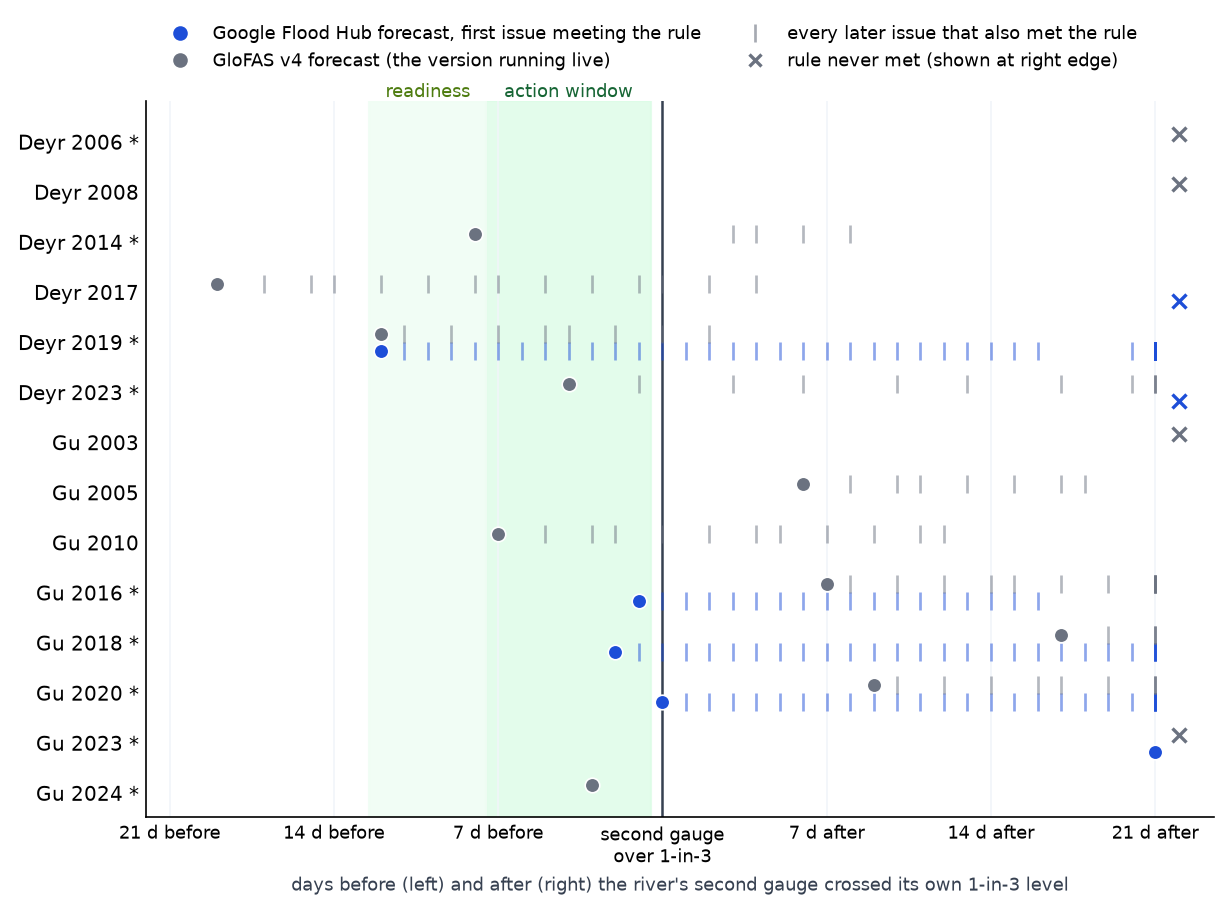
In Deyr, GloFAS v4 activated before the second gauge crossed in 4 of 6 seasons and was first in 2 of the 3 seasons both archives cover. In Gu, Google was first in all 4. On the Shabelle it gave 10 to 13 days of warning in three of four seasons, where GloFAS v4 gave 3 days once and nothing in the other three. The lead-time comparison and the calibration were done independently.
Flood by flood
| Season | River(s) that flooded | Second gauge over 1-in-3 | Google Flood Hub forecast | GloFAS v4 forecast | First |
|---|---|---|---|---|---|
| Deyr 2006 * | Juba and Shabelle | 30 Oct | no archive | rule never met | |
| Deyr 2008 | Juba and Shabelle | 15 Nov | no archive | rule never met | |
| Deyr 2014 * | Juba and Shabelle | 20 Oct | no archive | 8 d beforeShabelle, 12 Oct | |
| Deyr 2017 | Juba | 7 Nov | rule never met | 19 d beforeJuba, 19 Oct | GloFAS v4 |
| Deyr 2019 * | Shabelle | 14 Oct | 12 d beforeShabelle, 2 Oct | 12 d beforeShabelle, 2 Oct | tie |
| Deyr 2023 * | Juba and Shabelle | 25 Oct | rule never met | 4 d beforeJuba, 21 Oct | GloFAS v4 |
| Gu 2003 | Shabelle | 11 May | no archive | rule never met | |
| Gu 2005 | Juba and Shabelle | 12 May | no archive | 6 d afterShabelle, 18 May | |
| Gu 2010 | Juba and Shabelle | 18 May | no archive | 7 d beforeShabelle, 11 May | |
| Gu 2016 * | Juba and Shabelle | 1 May | 1 d beforeShabelle, 30 Apr | 7 d afterShabelle, 8 May | |
| Gu 2018 * | Juba and Shabelle | 17 Apr | 2 d beforeJuba, 15 Apr | 17 d afterJuba, 4 May | |
| Gu 2020 * | Juba and Shabelle | 22 Apr | same dayShabelle, 22 Apr | 9 d afterJuba, 1 May | |
| Gu 2023 * | Juba and Shabelle | 25 Mar | 32 d afterShabelle, 26 Apr | rule never met | |
| Gu 2024 * | Juba and Shabelle | 8 May | no archive | 3 d beforeJuba, 5 May |
SWALIM's alerts
SWALIM's bulletins were first in 6 of the 8 seasons in which both SWALIM and the window's source flagged, and SWALIM alone flagged in 5 further seasons. First means the bulletin date against the day the window's rule was met on the source's own record, since GloFAS version 5 has no forecast archive. The bulletins are issued ahead of the flood, and a SWALIM moderate flood risk alert for either river activates readiness. They cannot carry the action phase, because CERF needs an activation basis that can be backtested and the bulletins are expert judgement rather than a fixed rule.
SWALIM against the window's source, season by season
| Season | River | SWALIM first bulletin | Who was first |
|---|---|---|---|
| Deyr 2006 | Juba | 2006-10-31 | GloFAS v5 2 d before SWALIM |
| Deyr 2006 | Shabelle | 2006-10-31 | SWALIM 2 d before GloFAS v5 |
| Deyr 2014 | Juba | 2014-10-15 | SWALIM only; GloFAS v5 rule never met on its record |
| Deyr 2014 | Shabelle | 2014-10-15 | SWALIM 2 d before GloFAS v5 |
| Deyr 2019 | Juba | 2019-10-22 | SWALIM only; GloFAS v5 rule never met on its record |
| Deyr 2019 | Shabelle | 2019-10-22 | GloFAS v5 9 d before SWALIM |
| Deyr 2020 | Shabelle | 2020-09-08 | no bulletin for the October rise |
| Deyr 2023 | Juba | 2023-10-20 | SWALIM 9 d before GloFAS v5 |
| Deyr 2023 | Shabelle | 2023-10-21 | SWALIM 20 d before GloFAS v5 |
| Gu 2016 | Shabelle | no bulletin | no SWALIM bulletin; Google 12 May |
| Gu 2020 | Juba | 2020-04-27 | SWALIM 2 d before Google |
| Gu 2020 | Shabelle | 2020-04-27 | SWALIM 3 d before Google |
| Gu 2021 | Juba | 2021-05-10 | SWALIM only; Google rule never met on its record |
| Gu 2021 | Shabelle | 2021-05-10 | SWALIM only; Google rule never met on its record |
| Gu 2023 | Shabelle | 2023-05-08 | SWALIM only; Google rule never met on its record |
| Gu 2024 | Juba | 2024-05-09 | Google record ends 2023 |
| Gu 2024 | Shabelle | 2024-04-19 | Google record ends 2023 |
What runs live, and what is open
- Google Flood Hub serves all seven points. Dollow's design point (hybas_1121038740) was not in the live API; since 15 September 2026 Dollow reads the Juba main-stem gauge hybas_1121039440, which the API serves.
- Two gauges have stopped reporting. Bardheere has not reported since 30 November 2023 and Bualle since 14 March 2024.
- Impact years are not yet defined. The benchmark is gauge levels rather than people affected: 2013 activates with no gauge flood, and 2021 has 400,000 people affected with no gauge flood. Each window holds three to five severe seasons, so one event changes a window's scores.